Sales Tools for B2B Revenue Teams
How to cut through 2,100 sales tools and build a stack that actually works.
There are 11,000+ sales tools out there right now, but the SalesTech market teams actually buy from sits at over 2,100 solutions in 2025, up 34% from the year before. That growth outpaces any team's ability to shop rationally, which is how most revenue orgs end up with a stack built one panic purchase at a time. This piece is not a ranked list of winners. It is a map of what each category actually does, versus what vendors claim it does.
The stakes are real: the global B2B SaaS market hit $497.41 billion in 2025 and is projected to reach $634.39 billion in 2026. That growth is fueling vendor proliferation, and buying without a clear category framework in a market this crowded means paying for multiple tools that duplicate the same function.
How B2B buyer behavior has changed in 2025
Gartner's June 2025 survey found 61% of B2B buyers prefer a rep-free buying experience, and 70% to 80% of the journey completes before a sales rep is ever contacted. Forrester's 2025 Buyers' Journey Survey puts the average B2B purchase at 13 internal stakeholders and 9 external participants. Per Forrester, 89% of B2B buyers now use generative AI to conduct their own research before engaging with any vendor.
G2's 2025 Buyer Behavior Report found that GenAI chatbots are now the single most influential source for vendor shortlists, at 17.1%, ahead of software review sites (15.1%), vendor websites (12.8%), and peer recommendations (8.9%). 6sense's 2025 Buyer Experience Report, which surveyed more than 4,000 B2B buyers, found 94% of buying groups rank their preferred vendor before speaking to a rep, and 84% of those groups end up buying from the first vendor they contacted.
Gartner found buyers are 1.8 times more likely to close a high-quality deal when digital tools and a human rep work together. The tools that matter most are the ones that get a vendor in front of buyers before a preference is formed, not only the ones that support reps once contact is made.
What AI has changed for revenue teams
Salesforce's State of Sales 2026 report, based on 4,050 sales professionals, found 87% of sales orgs already use AI in some form, and 92% plan to increase spending on it next year. Gartner found sellers who use AI effectively are 3.7 times more likely to hit quota. Deloitte Digital's February 2026 study of 1,060 B2B suppliers and buyers found digitally mature suppliers beat their annual sales-growth targets by 110% more than less mature competitors.
IBM's State of Salesforce 2025-2026 report found 53% of organizations cite poor data quality as the top barrier to AI adoption. AI tools do not correct data quality problems; they process low-quality data faster and with greater confidence. This applies to every AI-enabled category covered below.
AI is now integrated into CRMs, engagement platforms, call recorders, and forecasting tools rather than existing as a separate layer. Efficiency gains are typically cited around 10-15%, primarily by increasing pipeline output per rep rather than reducing headcount.
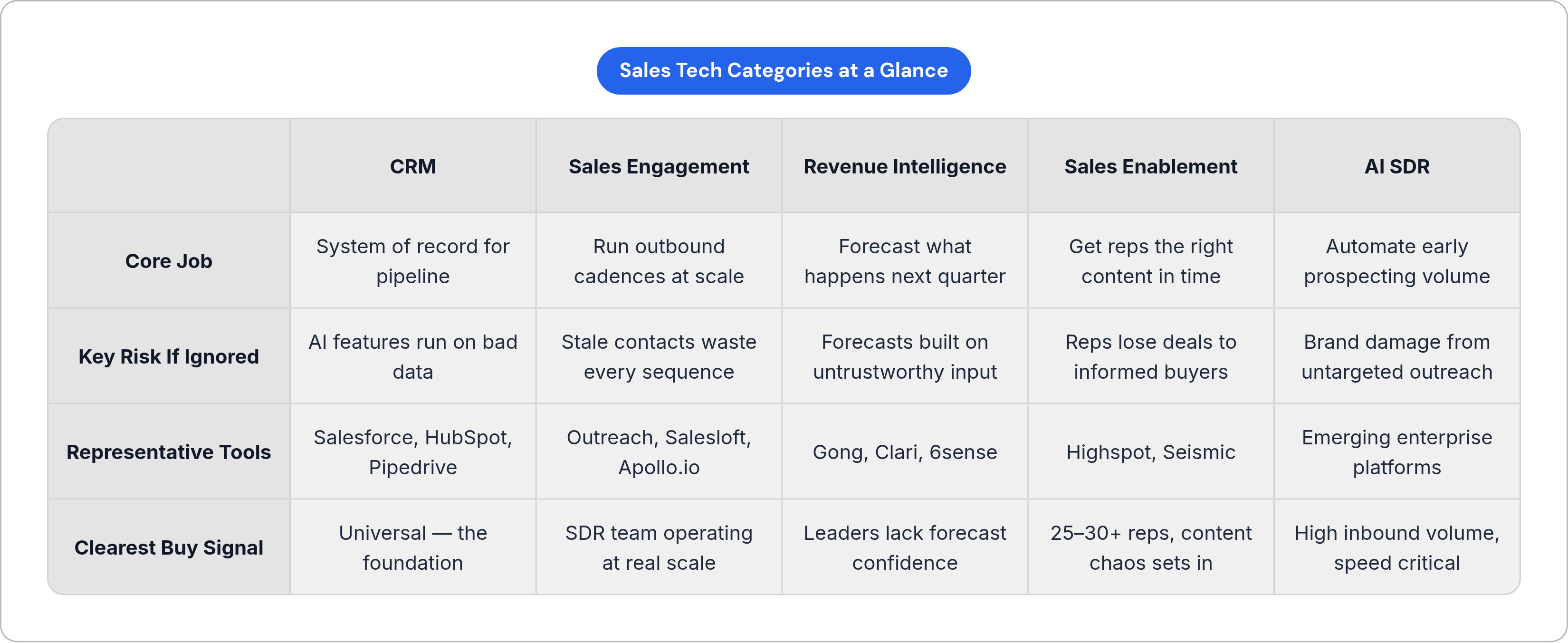
CRM: the foundation every other tool depends on
CRM adoption sits at 87% according to Trykondo's 2025 B2B Sales Trends report. Only 35% of sales professionals fully trust their CRM's data accuracy. That gap creates a compounding problem: AI-driven features such as lead scoring and deal-health alerts are only as reliable as the data they are trained on, and two out of three reps currently distrust that data.
The main platforms serve distinct segments. Salesforce is built for enterprise organizations with the budget and implementation resources to match, and its Agentforce system now layers AI agents directly into the platform. HubSpot fits the growth-stage and mid-market segment with a lower implementation burden and AI features that have improved substantially in recent releases. Pipedrive targets SMBs with straightforward pipeline visibility rather than enterprise configurability.
Choosing a CRM means choosing a data architecture that every other tool in the stack will read from or integrate with. The 35% data-trust figure is a direct constraint on how much value AI features built on top of that data can actually deliver.
Sales engagement platforms: running outbound at scale
Sales engagement platforms manage cadences across email, phone, and LinkedIn so outreach is systematic and sequenced. Any SDR team operating at real scale in 2025 is almost certainly running one. The category has split into two tiers by complexity and team size.
Outreach, which is positioning itself as an AI platform for revenue teams, and Salesloft, which merged with Clari in December 2025 into a combined forecasting-and-engagement platform, serve enterprise teams. Both offer deep workflow customization and typically run at $100 or more per user per month, with implementation timelines measured in weeks.
Apollo.io serves SMB and mid-market teams with a database of hundreds of millions of verified contacts, multichannel sequencing, AI-written emails, and a parallel dialer bundled into one tool. Newer deliverability-focused tools like Instantly and Smartlead use unlimited-user pricing and faster setup, with better unit economics for outbound-heavy teams under roughly 30 reps.
Enterprise platforms are appropriate when configurability is the priority. Smaller, faster tools are more cost-effective when workflow complexity is low. Cold email reply rates sit in the low single digits industry-wide; meetings booked per rep is the metric that indicates whether cadences are working. The Salesloft-Clari merger signals that the market is consolidating engagement and forecasting into unified revenue platforms, which will increase pressure on standalone point solutions.
Sales intelligence and data: targeting the right accounts
Sales intelligence answers which accounts to contact and why the timing is relevant now. It covers contact data, firmographics, technographic signals, and intent data.
LinkedIn is the dominant channel for B2B relationship-building, and reps who use social selling consistently generate more pipeline than those who do not. ZoomInfo is the enterprise standard for contact and intent data, with a broad database and deep integrations; its 2026 taxonomy formally defined the sales engagement platform and revenue intelligence categories. LinkedIn Sales Navigator provides direct access to LinkedIn's first-party data, which makes it close to mandatory for enterprise and strategic account selling. Apollo.io also belongs in this category because it combines a contact database with sequencing in a single product.
Intent data, signals indicating that an account is actively researching a category, is what separates a prioritized target list from an undifferentiated spreadsheet of names. A strong engagement platform running on stale or inaccurate contact data will produce outreach to people who changed roles months ago, reducing deliverability and wasting rep time.
Revenue intelligence: forecasting future pipeline accurately
CRM records historical activity. Revenue intelligence uses that activity data, plus conversation signals and engagement patterns, to forecast what will happen next quarter and surface deals at risk before they close lost.
Gartner's research shows 55% of sales leaders do not have high confidence in their own forecast accuracy, and only 7% of sales orgs hit forecast accuracy of 90% or higher. The revenue intelligence market sat around $1.2 billion in 2024 and is projected to reach $3.5 billion by 2033. In December 2025, Gartner published its first Magic Quadrant for Revenue Action Orchestration, formally recognizing that conversation intelligence, engagement, and forecasting are converging into one category.
Gong leads on conversation analytics and deal inspection, with forecasting reported to outperform CRM-only predictions by a meaningful margin; pricing runs roughly $100 to $130 per user per month plus a mandatory platform fee, pushing enterprise deployments into six figures. The merged Clari and Salesloft platform is the most visible example of engagement and forecasting combining into a single product. 6sense combines intent data and account-based marketing with forecasting, with entry pricing typically starting above $50,000 per year. Avoma covers conversation and revenue intelligence at a price point more accessible for mid-market teams.
The 53% data-quality barrier IBM identified applies directly here. A forecasting model built on incomplete pipeline data produces unreliable outputs regardless of how sophisticated the underlying model is.
Sales enablement: delivering the right content to reps
A large majority of organizations now run a dedicated enablement function. Enablement platforms are reported to reduce rep ramp time meaningfully and reduce the time reps spend searching for current sales materials.
The priorities organizations report pursuing most often are value messaging and process optimization. Both reflect a quality problem rather than a volume problem. Most teams have more content than they can manage; the gap is in surfacing the right content at the right point in a deal.
Highspot leads on content management, guided selling, and analytics that identify which materials advance deals rather than sitting unused. Seismic holds a comparable position with particularly strong integration into Salesforce and Microsoft environments. Teams crossing roughly 25 to 30 reps typically find content management becomes unmanageable without dedicated tooling. Both Highspot and Seismic now include real-time coaching, live call scoring, and mid-call content suggestions as current features.
Given that buyers arrive having already completed significant independent research, reps who are not equally well-prepared lose credibility early in the conversation. Enablement tooling directly addresses that gap.
AI SDRs: capabilities and current limitations
The AI SDR market was valued at $4.27 billion in 2025, and it is projected to grow from $5.22 billion in 2026 to $24.32 billion by 2034, a 21.2% compound annual growth rate. A substantial share of enterprise B2B teams report at least one AI SDR running in production as of Q1 2026, up significantly from a year prior.
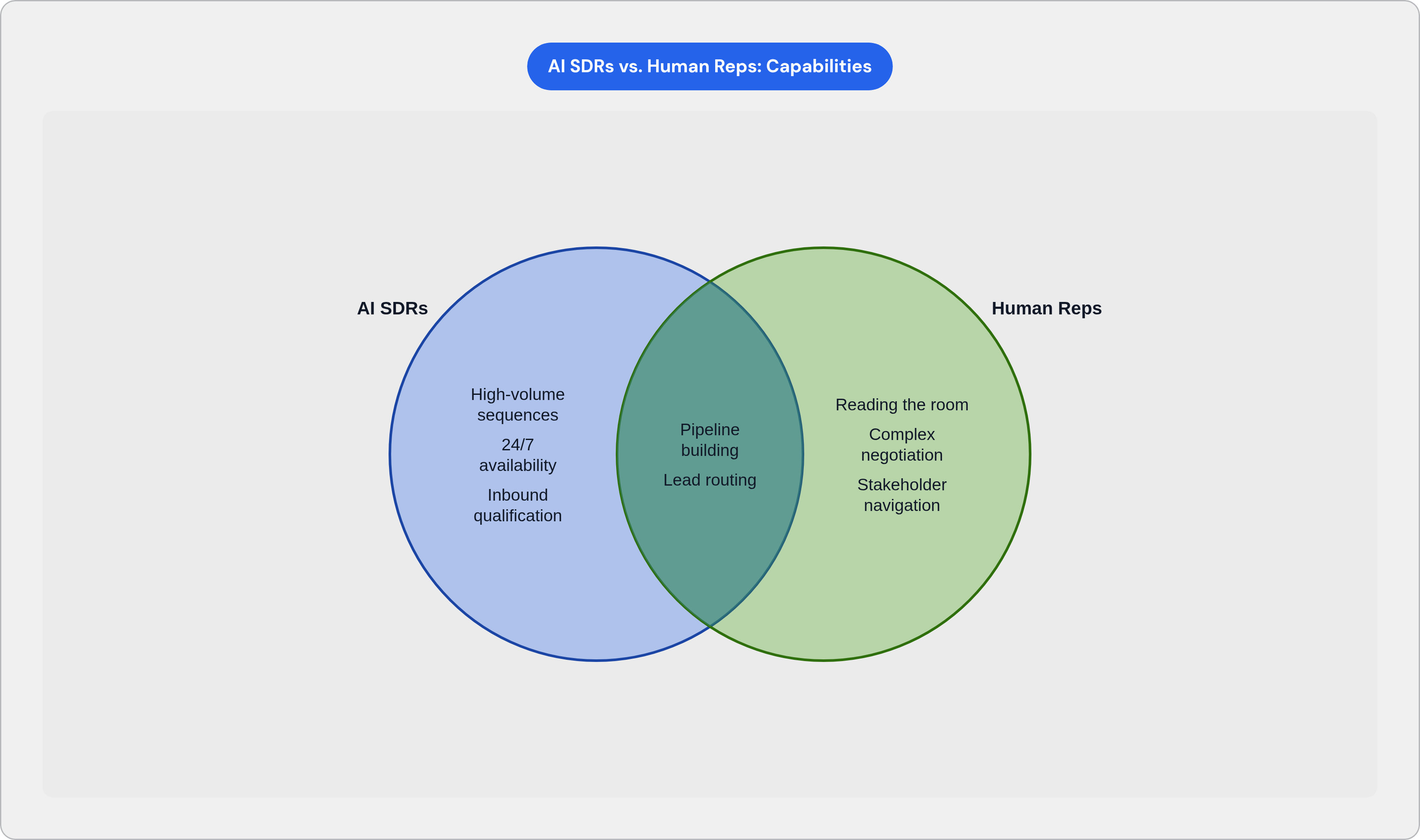
Current AI SDR tools perform well at running high-volume prospecting sequences, qualifying inbound leads against defined rules, handling basic objections over email, and routing qualified conversations to a human. They do not perform well at managing deals with multiple stakeholders pulling in different directions, responding credibly to complex objections, or building the trust that Gartner's research associates with high-quality deal outcomes.
An AI SDR running on poor contact data without human oversight does not just waste budget; it produces outbound at scale that harms sender reputation and deliverability. Salesforce's State of Sales report found 94% of sales leaders using AI agent software consider it critical to meeting business demand, but that figure covers a wide range of deployment models from tightly supervised to fully autonomous. AI SDRs are most effective as a capacity tool for early-stage, lower-complexity conversations where response speed matters more than nuanced judgment. North America held 39.4% of the AI SDR market in 2025, which means the category remains primarily optimized for English-language outbound.
CPQ: reducing friction at the quoting stage
CPQ (configure, price, quote) software exists to eliminate errors and delays in the quoting process. Once a product has multiple pricing tiers, discount approval layers, bundles, or usage-based components, manual quoting in spreadsheets creates financial and legal exposure. A rep submitting an incorrect discount that clears without review produces a signed order form that does not match approved pricing, which requires finance intervention to resolve after the deal has closed.
The main tools in this space, including Salesforce CPQ and DealHub, sit downstream of the CRM and connect to contract and billing systems. Teams typically underinvest in CPQ until the deal desk becomes a bottleneck in the sales cycle, at which point adoption requires process changes across sales, finance, and legal simultaneously.
Given that buyers complete 70-80% of their research independently and frequently have a vendor preference before first contact, response speed at the quoting stage is a competitive factor. Buyers who are ready to move forward will not wait through multi-day manual approval processes. Teams that treat CPQ as a back-office tool rather than a revenue-cycle tool typically discover the cost of that framing in deal reviews where extended quote turnaround times are identified as a contributing factor in losses.