Sales Promotion Examples in SaaS and Tech
Six SaaS promotion formats handle different jobs at each stage of the buyer journey.
SaaS promotions come down to six formats: free trials, freemium, annual discounts, seasonal deals, referral programs, and lifetime deals. Every serious company picks from that same short menu. The winners aren't inventing something new, they're matching the format to the buyer and the moment.
Here's why that match matters more than it used to. Acquisition costs jumped 14% in 2024, according to a NinjaPromo report from 2025, and companies now spend roughly two dollars to get one dollar of new customer revenue. That math used to run the other way. And per the 6sense 2025 B2B Buyer Experience Report, buyers finish about 70% of their evaluation before a salesperson ever picks up the phone. Most of the persuading happens before anyone at your company even knows a deal exists. Promotions have quietly taken over a chunk of the job sales reps used to do, except nobody's in the room to notice.
So let's go format by format. How real companies use each one, and why.
The main promotion formats SaaS companies actually use
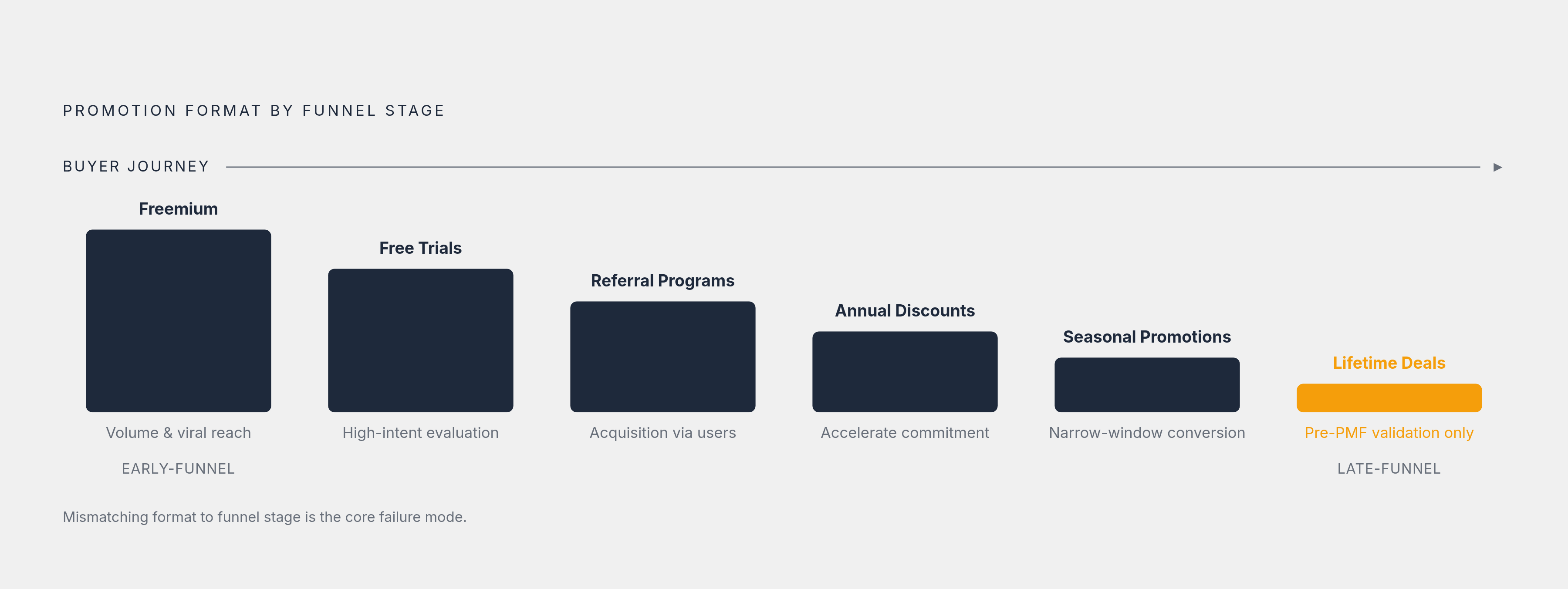
Free trials, freemium, annual-plan discounts, seasonal or event-based promotions, referral programs, lifetime deals. Six formats, and they keep showing up because each one lives at a different point in the buyer's journey and does a different job. Some chase volume at the top of the funnel. Some lock in commitment once someone's already sold. Others stretch out lifetime value long after the deal closes.
Product-led growth (PLG) isn't a seventh format sitting on the shelf next to these. It's more of an operating philosophy that shapes a few of them, especially how freemium tiers get designed and how trial onboarding gets measured.
Picking the right format comes down to four questions. How complicated is the product? What does it cost? Are you selling self-serve or through a sales team? Where does the buyer sit in their evaluation? Answer those honestly and the format mostly picks itself.
Free trials — the dominant entry point, and the conversion math behind them
Free trials are the default, full stop. ChartMogul surveyed 200 products in January 2026 and found trials used by more than twice as many products as freemium. It's the front door almost everyone builds, whether or not they've thought hard about why.
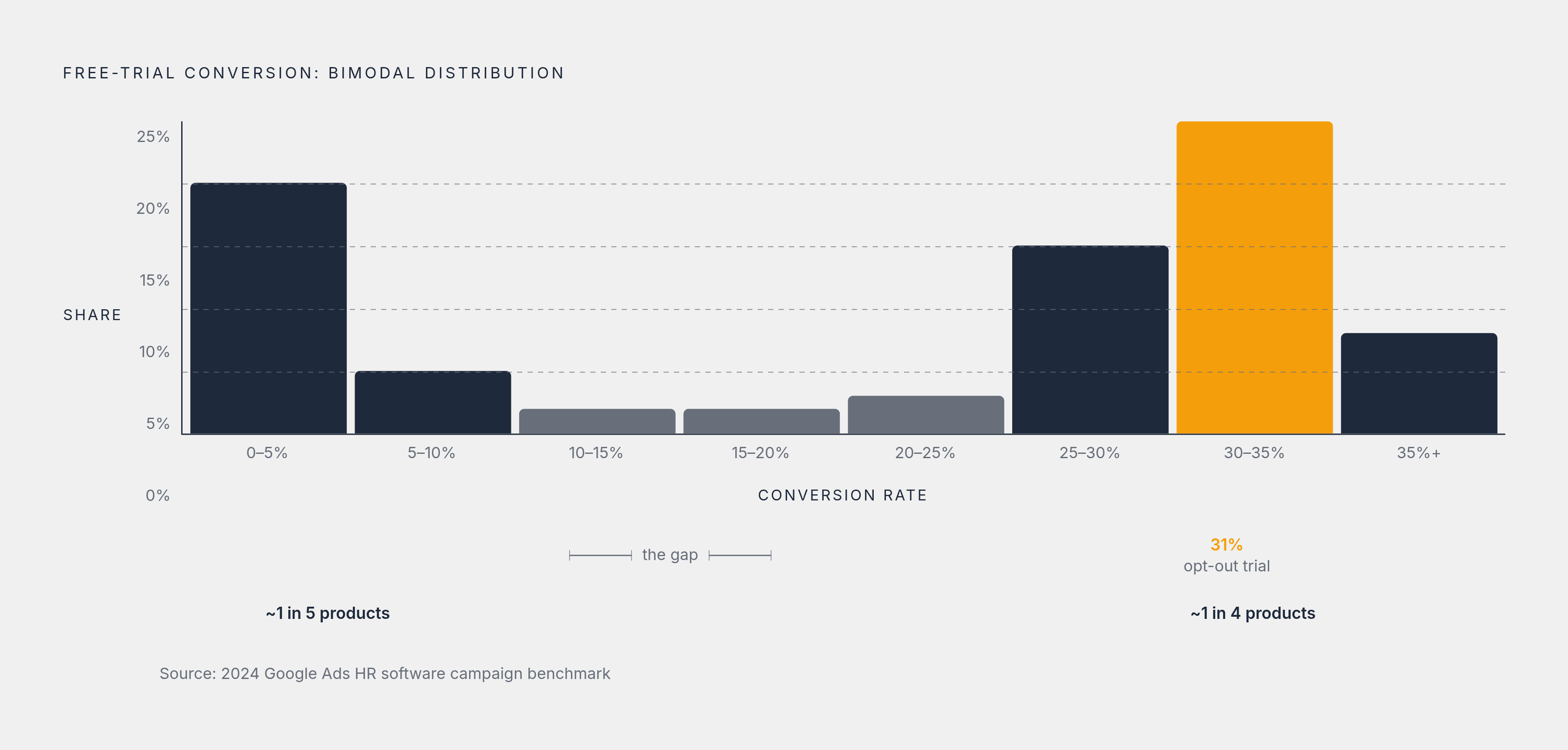
But "free trial" hides two very different structures, and the gap in outcomes isn't subtle. Opt-out trials, the kind that ask for a credit card before you've touched the product, converted at roughly 31% in a 2024 Google Ads campaign for HR software. Strong number, and it makes sense: someone who hands over a card is already halfway committed. Opt-in trials, no card required, convert lower. You're trading intent for volume. More people walk in the door; fewer of them were ever going to buy.
The distribution across products is bimodal, not a bell curve. Roughly one in five products converts below a very low threshold. Roughly one in four converts above 25%. There's no "normal" trial conversion rate, just a crowd that's struggling and a crowd that's cracked the code, with not much sitting in between.
Trial length clusters the same way. Fourteen days is standard; seven-day and thirty-day trials each make up a much smaller slice of the market. Shorter trials create urgency, but only if onboarding gets someone to their "aha moment" fast. Give someone a week and bury the useful feature on day nine, and you've built a countdown clock to nowhere.
Even "self-serve" trial products usually add a human the second an enterprise user shows up. The top of the market still wants to talk to a person, even inside a flow that's supposedly hands-off.
Industry matters more than most benchmarks admit, too. CRM tools and IoT tools tend to beat enterprise software and cybersecurity on trial conversion, so a benchmark pulled from a different category is basically noise dressed up as insight. Channel matters just as much: high-intent paid search converts trial signups into paid customers at roughly double the rate of social or display, even with the identical product and identical onboarding flow. Same trial, same emails, wildly different outcome, and it comes down entirely to where the person came from before they hit your signup page.
Ask this about any trial you're running: is it built to get someone to a value moment inside the window, or is it just built to expire?
Freemium — when giving the product away is the distribution strategy
Freemium is a different animal, and people mix it up with free trials constantly. There's no clock running out here. The free tier is meant to be permanent, functional, and good enough that a real chunk of users never pay a cent. On purpose.
The logic rests on distribution, not conversion. One person signs up, invites their team, the team invites collaborators, and the product spreads through an organization without a single sales call.
Slack caps free-tier message history at a 90-day window, which gives a team enough runway to build a daily habit before hitting the upgrade wall. That patience paid off; Slack grew to tens of millions of daily active users riding this exact mechanic. Canva lets you do real design work for free but puts premium templates and brand kits behind the paywall, so the moment you outgrow the basics is also the moment you're staring at a pricing page. Notion turned its template marketplace into its own distribution channel; creators share templates publicly, and those templates pull in new signups through search and social without Notion lifting a finger. HubSpot gives away its CRM outright, because once your customer data lives inside HubSpot, moving it becomes a hassle, and every adjacent product HubSpot sells turns into an easy add-on instead of a hard sell.
Conversion rates on freemium sit in a low single-digit range, well below either trial model. Sounds bad until you remember the game rewards volume over percentage. A 2023 OpenView Advisors report found PLG companies valued more than 30% higher than their peers, and freemium is the most common mechanic behind PLG. That valuation premium is a big part of why companies keep building free tiers even when the conversion math looks weak on a spreadsheet.
The tension never goes away: give away too little and nobody sticks around long enough to form a habit. Give away too much and there's no reason to ever upgrade. Basic freemium, one flat free tier and one paid tier, is showing diminishing returns industry-wide. What's replacing it: a free tier with specific, well-chosen paid add-ons (premium integrations, advanced analytics) that create small upgrade moments without smothering the free experience in nags.
Annual-plan discounts — the most common SaaS pricing incentive and why the math favors it
If free trials are the front door, annual discounts are the furniture everyone eventually buys. They're the single most common SaaS incentive, nearly universal across self-service products. Not an accident. The trade benefits the vendor at least as much as the buyer.
The standard pitch is "two months free," landing somewhere around a 16 to 20% discount on annual versus monthly billing. A PricingSaaS survey from 2025, covering 50 self-service products, found a median yearly-to-monthly ratio of 125%. That's the going rate, more or less, across the industry.
Why do vendors keep handing out the discount? A few reasons stack on top of each other. Annual billing cuts churn substantially compared to monthly, since a customer who's already paid for the year isn't reconsidering every 30 days. Cash comes in upfront instead of trickling in monthly, which matters if you're funding hiring or product work. Revenue gets more predictable, which matters enormously for planning and for how a company looks to investors. Payment processing fees drop sharply when you're running one transaction a year instead of twelve.
Multi-year deals faded during the 2023 to 2024 pullback, when buyers got skittish about locking in long commitments, but they came roaring back in 2025. MostlyMetrics analyzed thousands of contracts across hundreds of suppliers between 2022 and 2025 and found the gap between single-year and multi-year pricing is now the widest it's been in that stretch. Multi-year deal incidence climbed from roughly 25% of contracts in 2022 to about 30% in 2025.
Here's the trap: the discount should track actual churn reduction and cash flow benefit, not whatever the competitor down the street is offering. Discount too steeply just to match the market, and you're eroding lifetime value without buying any extra retention for it.
Seasonal promotions — Black Friday as SaaS's single biggest promotional event
Software mostly ignores Christmas and skips the January sale entirely. Black Friday and Cyber Monday are where SaaS shows up, according to Paddle, and it's really the one seasonal event that matters in this industry.
The structure is simple on purpose. A fixed window, a steep discount, a hard deadline. Scarcity and urgency do the conversion work that SaaS pricing normally avoids the other 360 days of the year.
Adobe's 2024 approach is worth studying because it split the event in two: one campaign for Black Friday, a separate one for Cyber Monday, each offering a sizable discount on the first year of a new Creative Cloud subscription, according to Bantrr's December 2025 reporting. Across the broader market that same year, discount depth ranged from modest single-digit offers all the way up to half off first-year annual plans. The depth tended to track how competitive the category was and how established the brand already was. Bigger, safer brands could afford to discount harder because they weren't worried about training their base to expect fire sales forever.
Paddle's data shows something that runs against the obvious assumption: subscribers who sign up during Cyber Weekend actually carry longer customer lifetime value than expected. The instinct that a discount buyer is automatically flaky and churny just doesn't hold up for BFCM in this industry.
There's a catch, though. Run the same deep discount every November, and a segment of your buyers will simply learn to wait for it. The calendar promotion turns into a standing price expectation, and you've quietly reset what "full price" means to a chunk of your market.
BFCM works best on buyers who were already evaluating and just needed a shove. It's a late-funnel tool, not an early-funnel one, and expecting it to build awareness from cold traffic is asking it to do a job it was never built for.
Referral programs — building a growth loop where customers do the acquisition
Dropbox is the textbook case here, and it's still worth studying because almost nobody has topped it. The mechanic was a double-sided reward: both the person referring and the person invited got extra storage. Built directly into the product, right at the moment users hit their storage limit, which is exactly when someone's motivated to do something about it.
Over roughly 15 months, the program drove dramatic growth, and referred users showed meaningfully higher retention and higher average spend than everyone else. The economics explain why Dropbox leaned so hard into it: their cost to acquire a customer through paid channels significantly exceeded what that customer paid annually. A referral loop cost a fraction of that. At its peak, referrals accounted for a substantial share of Dropbox's daily signups, functioning as a primary acquisition channel rather than a side experiment.
A few design choices made this work, and none of them were accidental. The reward was more product, not cash, which reinforced the actual value of using Dropbox instead of just paying people to spam their contacts. The sharing mechanism lived inside the product flow itself, not tucked away on some separate referral page nobody visits. The rules were plain, and the reward showed up instantly. No waiting period, no fine print. The whole loop fired at a real pain point, the moment someone ran out of storage, rather than some arbitrary "please share this" popup.
Referral only works for products people are willing to be seen using, though. Nobody's referring their friends to a debt collection tool. You need a product worth bragging about, plus a natural moment where sharing makes sense.
Lifetime deals — acquiring early users and the structural risk vendors carry
AppSumo runs the dominant marketplace for lifetime software deals, pairing early-stage SaaS companies with a community of buyers happy to pay once for access forever. The pitch to the buyer is simple: permanent access at a price far below what the ongoing subscription would ever cost. These discounts run steep, deeper than anything you'd see in a seasonal sale or an annual plan.
For the company running the deal, the payoff is speed. AppSumo helped Pictory grow from a small user base to roughly 6,000 users in two months. Komodo Decks sold more than 6,000 licenses through the same platform. That's rapid validation, real usage data, and a user base most early-stage companies would otherwise spend a year and a marketing budget chasing.
The catch lives on the vendor's balance sheet, and it's a lasting one. A lifetime deal is a deferred cost wearing a discount's clothing. Server costs, support tickets, and ongoing development don't stop just because the customer paid once. AppSumo also takes the majority of the sale, leaving vendors with about 30%. And the buyers who show up for lifetime deals often skew toward deal-hunters rather than the company's actual target customer, which may or may not line up with where the product's roadmap is headed.
LTDs make sense at a specific moment: pre-product-market fit, when learning from real users matters more than squeezing out revenue, or when a company needs a user base fast to get network effects going. They stop making sense once a company finds its footing and shifts focus to lifetime value. At that point, the economics that made lifetime deals attractive flip and start working against you.
How to match a promotion format to a specific goal
Six formats, six different jobs. Free trials convert high-intent people who are already evaluating on their own; they work when onboarding can get someone to a real value moment before the clock runs out. Freemium builds organic distribution and top-of-funnel volume, and it needs a sharing or collaboration mechanic plus a free tier that creates a genuine habit, not just a taste.
Annual discounts accelerate commitment and cut churn. They land best with a buyer who's already decided and just needs a financial nudge to commit longer. Seasonal promotions convert late-funnel intent during a narrow window, so they need buyers who were already circling, not cold traffic pulled in off the street. Referral programs cut acquisition cost by turning customers into a sales force, and that requires a product worth sharing plus a natural trigger moment. Lifetime deals buy early-stage validation and a fast user base, which is why they belong before product-market fit, not after.
Companies rarely stop at one. Dropbox ran freemium and referral side by side. HubSpot runs freemium and annual discounts together. Adobe leans on annual discounts and stacks BFCM on top every November. These formats compound when the underlying product motion actually supports the combination. Staple them together without that alignment and you'll mostly just confuse your own funnel.
Remember that 70% figure from the opening: buyers are most of the way through their evaluation before your sales team even knows they exist. That reality favors low-friction, instantly credible formats, free trials and seasonal discounts, over slower-building mechanics like referral or lifetime deals, which need time to compound.
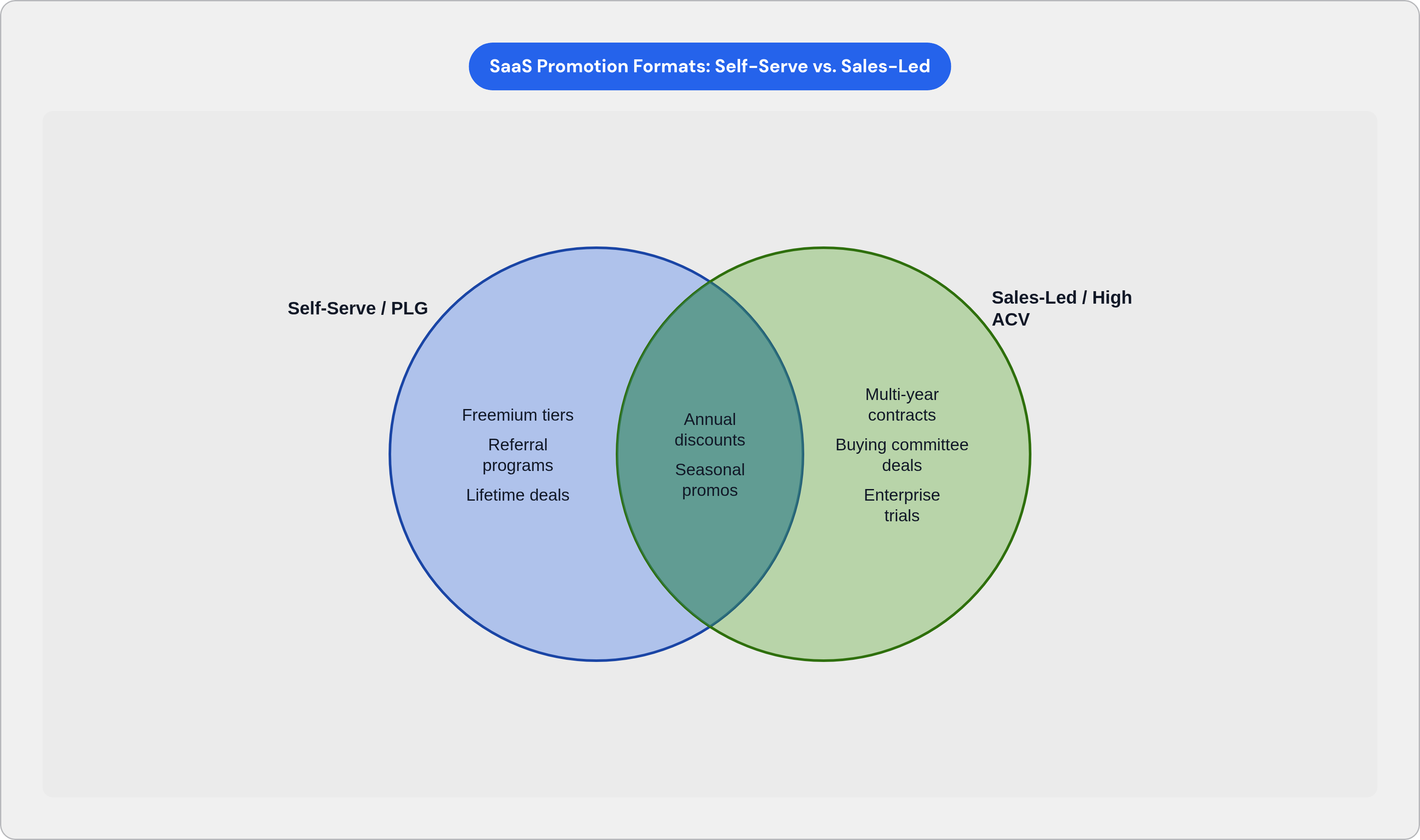
Price point changes the calculus too. Freemium and referral do their best work in self-serve, lower-cost products where one person can make the decision alone. As contract value climbs and a sales team gets involved, annual and multi-year discounts take over as the primary lever, because now you're negotiating with a buying committee, not convincing one person to click upgrade.
And measure each format on its own terms. Conversion rate for trials. Viral coefficient for referral. Churn delta for annual plans. Incremental revenue lift for seasonal events. Run the wrong metric against the wrong format and you'll walk away with a confident conclusion that happens to be dead wrong.