Sales Definition Inside a B2B Go-to-Market Motion
Blurry vocabulary on "sales" costs companies money in misaligned hiring and broken GTM execution.
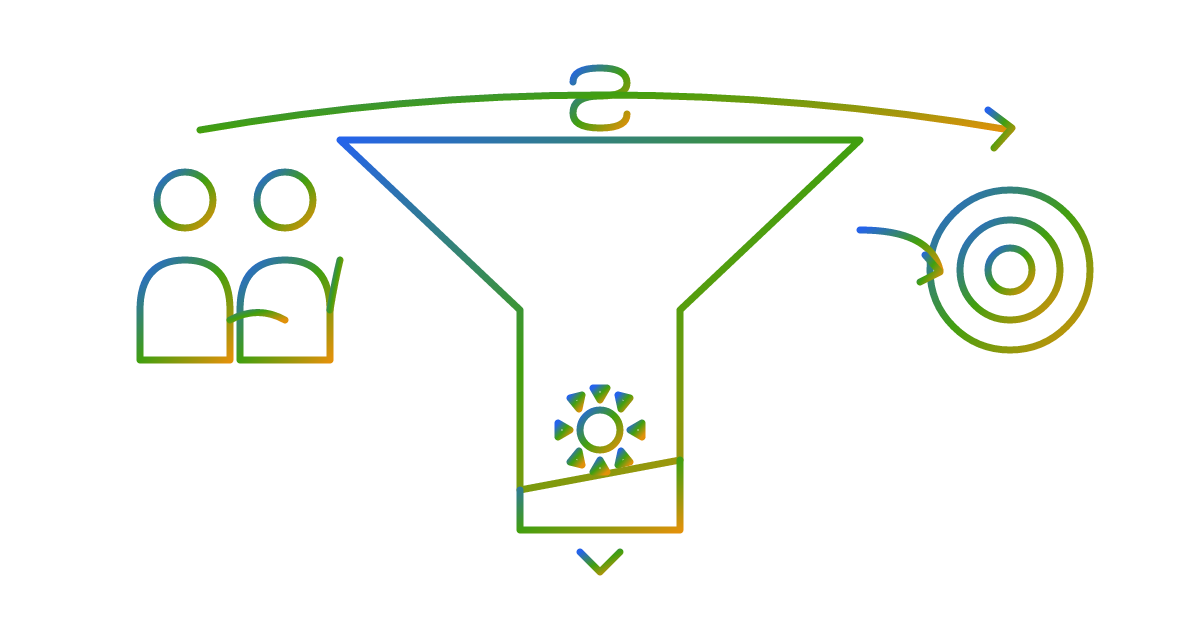
The word "sales" gets asked to do three jobs at most B2B companies: the function, the motion, and sometimes the whole revenue operation. That's a vocabulary problem, and it costs real money. Companies hire ten account executives before anyone bothers to map how a deal moves from stranger to signature, then act surprised when quota attainment looks like a car wreck nobody wants to clean up.
So here's the fix: get precise about what each word means and stop swapping them around. GTM strategy is the plan: target market, positioning, pricing, the message you put into the world. GTM motion is the machine that turns that plan into money, a repeatable pattern running across the whole customer journey. Sales motion is one slice of that machine: outreach, discovery, demo, negotiation, close. People mash all three into one word constantly, and every time they do, somebody on the team ends up doing a job nobody actually hired them for.
A GTM Motion Is Cross-Functional by Design
A GTM motion is the repeatable pattern a company uses to get its product in front of paying customers and get them to pay up. Product builds it. Marketing announces it. Sales closes it. Customer success keeps it alive. Account management grows it. Support holds the whole thing together when it breaks, which it will. Call it a department, or a campaign, or "whatever the sales team did last quarter that worked," and you've missed the point entirely: the coordination between all those pieces is what makes it run at all.
Six flavors of B2B motion exist: sales-led, product-led, marketing-led, inbound, outbound, and partner-led. Almost nobody runs just one. Most companies blend a few, and the blend isn't a taste preference. It comes down to how complex the product is, how big the contracts are, and how far along the company has gotten. Inbound tends to be the most common starting point, sitting around 23% primary adoption in 2025 according to The Digital Bloom's B2B GTM Benchmarks, but common doesn't mean exclusive.
Partner-led motion makes the case for cross-functional design better than any slide deck ever could. The Digital Bloom found partner-sourced deals close 53% more often, run 40% higher in average order value, and convert 46% faster than deals with zero partner involvement. No sales rep, however sharp, produces that lift alone. Revenue tied to partners grew from around 18 to 20% in 2024 to 26 to 28% in 2025 per that same research, and it grew in territory sales never even touches.
Where Sales Sits and Where It Stops
Sales converts qualified interest into signed revenue. That's the whole job, first discovery call to closed contract, nothing more and nothing less. Demand creation belongs to marketing. The product experience belongs to product. Retention after the ink dries belongs to customer success, and the data and systems belong to RevOps. Sales closes what everyone else brings to the door. It doesn't build the door, and it shouldn't be blamed when the door's in the wrong place.
Inside the sales function itself, the account executive is the center of gravity. The AE owns the deal end to end and gets measured on closed-won ARR against quota. Every other role in sales exists to protect the AE's time and keep their pipeline full.
SDRs and BDRs sit right on the seam between marketing and sales. They qualify interest and book meetings, then hand off instead of closing anything themselves. SDRs work inbound leads, BDRs cold-prospect into new accounts. Both get measured on qualified meetings booked, which is honest, given where they sit in the chain. A solid rep in either seat books somewhere around 8 to 12 qualified meetings a month, running 80 to 100 outbound touches a day across email, phone, and LinkedIn, according to SyncGTM.
RevOps is the referee keeping that whole boundary from collapsing. It owns the CRM, the lead routing rules, the stage definitions, and the forecast. Take RevOps away and sales starts treating the pipeline in front of it like the entire motion, when it's really just one gauge on the dashboard.
Then there's the GTM engineer, a role that barely existed a few years back and now shows up at 54% of fast-growing B2B SaaS companies, according to research from Clay and The Signal. The job is to wire marketing data straight into sales action, automate the handoffs, and keep the seam between functions from leaking revenue.
Bigger Buying Committees Make Boundaries Harder
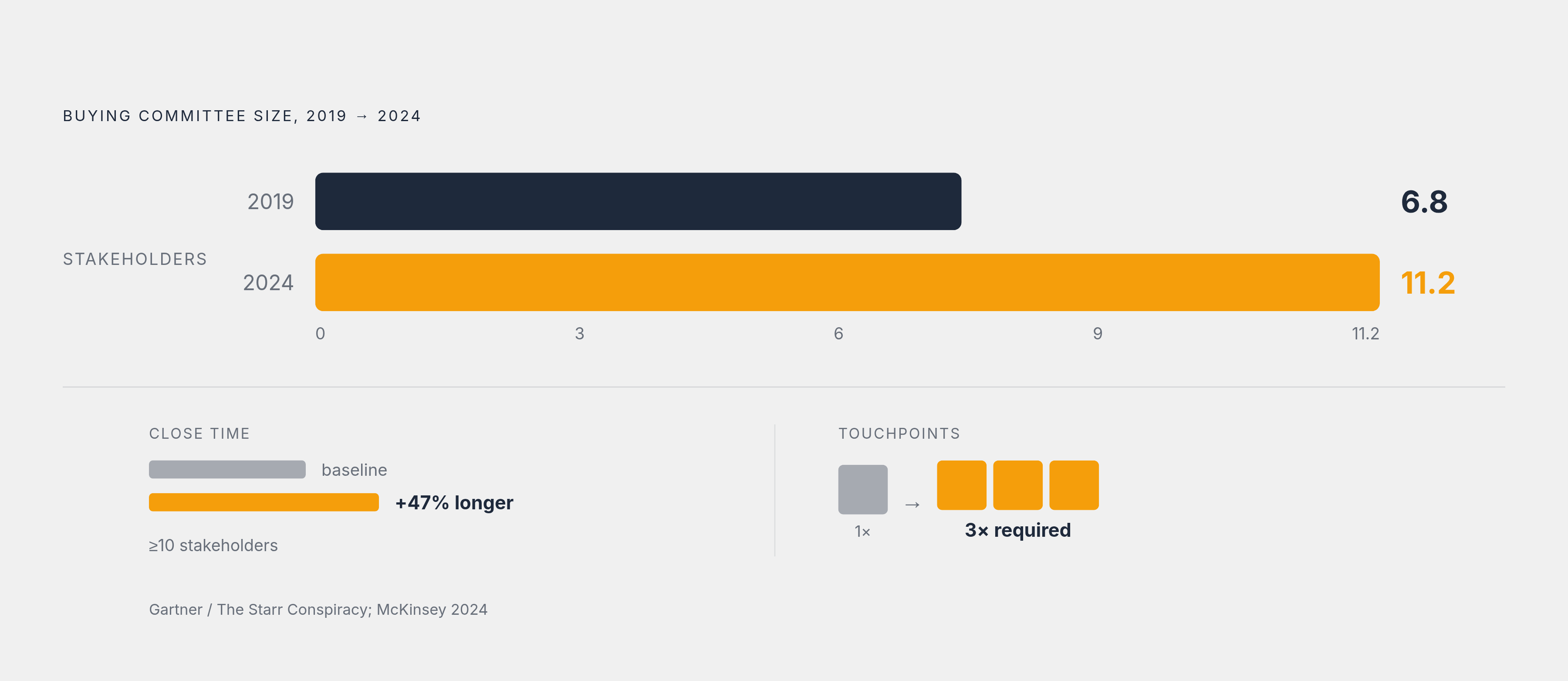
Buying committees keep growing, and not gently. Gartner research cited by The Starr Conspiracy put the average buying committee at 6.8 stakeholders in 2019; by 2024, that number hit 11.2. Enterprise SaaS deals aimed at Fortune 1000 accounts routinely pull in 9 to 22 stakeholders, with sales cycles stretching 9 to 18 months on the biggest named accounts.
McKinsey's 2024 research on B2B sales found deals with 10 or more stakeholders take 47% longer to close and need three times the touchpoints of smaller deals. No single AE covers that much ground alone, no matter how good they are on the phone. It takes marketing reaching people the AE will never get on a call, and it takes CS calming renewal anxiety that shows up before the deal has even closed. Forrester calls the resulting slowdown "decision paralysis," and it's common: 73% of enterprise purchases now run past their original timeline because internal alignment falls apart before anyone signs.
As committees grow, sales needs the rest of the motion more, not less. Ask sales to cover for the whole operation in an environment like this, and you're handing one person a job the motion was built to split across five. The bill comes due in the win rate. Gong's Revenue Intelligence Benchmark, drawing on 5.6 million recorded conversations from February 2024, puts the median win rate on qualified B2B SaaS opportunities at 21%. That's a design gap, not a talent gap.
Sales-Led and Product-Led Motions Are Stages
Sales-led growth runs on relationship selling: outreach, structured demos, negotiated contracts. It fits complex products, high contract values, and buyers who want a human walking them through the decision before they sign anything. Enterprise SaaS, B2B manufacturing, and IT platforms are the classic homes for SLG. Ebsta and Pavilion, surveying thousands of sales teams in March 2024, clocked the median enterprise sales cycle for deals over six figures at 84 days.
Product-led growth flips that whole model. The product does the convincing instead of a rep. Free access lets someone reach real value before they've paid a cent. OpenView Partners tracked PLG adoption at 45% in 2019, with adoption continuing to grow in the years since. It works best when a user hits their "aha" moment alone, in a single sitting, no rep required, and when contract values sit under roughly $10K with high transaction volume. A ProductLed survey found 58% of B2B SaaS companies already running a PLG motion, with 91% planning to invest even more.
The two work best stacked as stages, not pitted against each other as rivals. PLG builds the user base, then sales comes in afterward and converts the accounts worth converting: a pattern people now call "product-led sales," where CS and sales layer on top of signals the product already generated. Sales doesn't disappear in this model; its entry point just moves later, and its job gets narrower. Instead of creating demand from nothing, it closes the high-value tail the product already surfaced. The real difference between SLG and PLG comes down to timing: when sales shows up, and how much of the story it's actually responsible for telling.
Benchmarks Reveal Whether the Motion Works
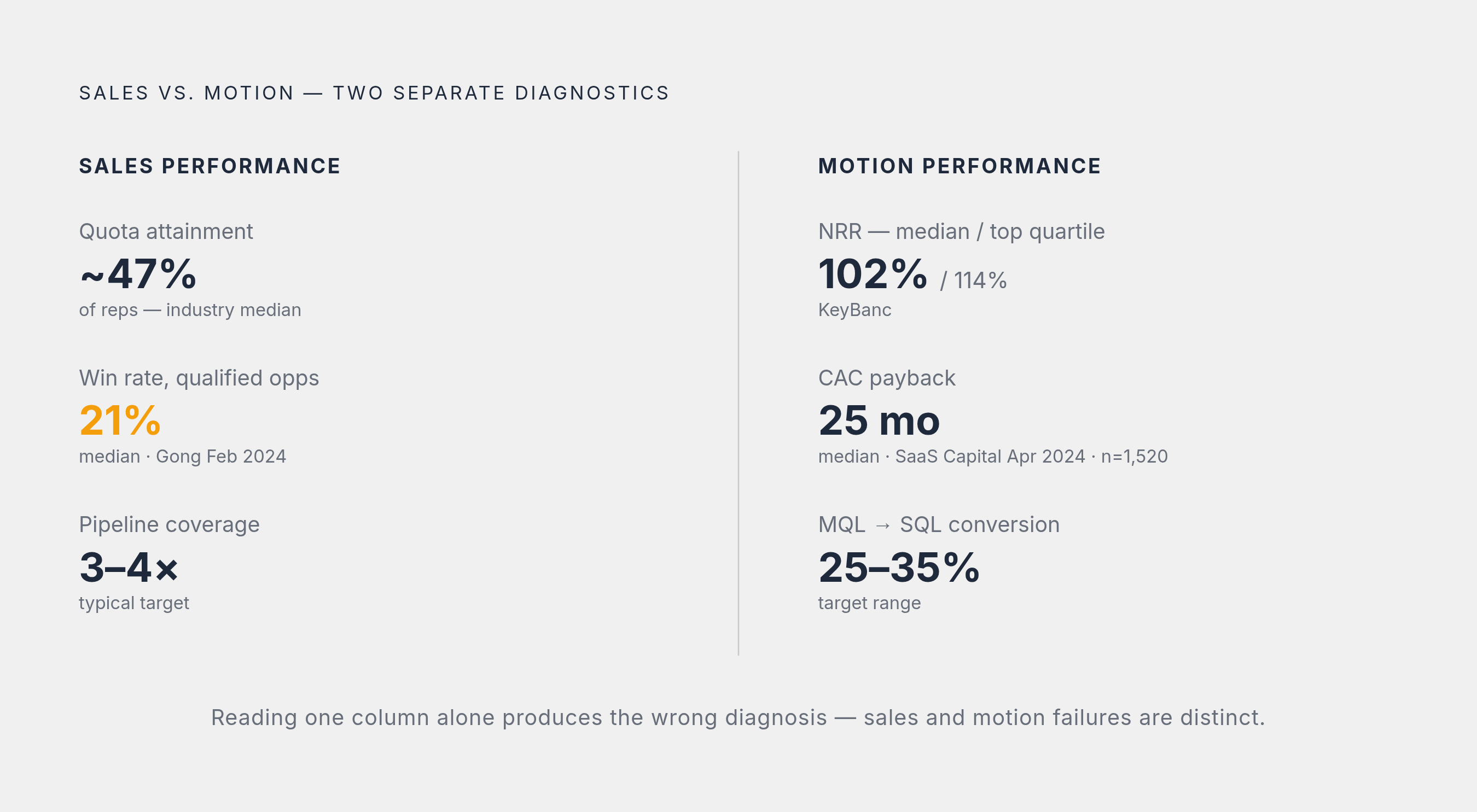
Win rate sits at 21% median on qualified opportunities, per Gong's February 2024 numbers, and ICP clarity shapes that figure as much as any one seller's skill does. MQL-to-SQL conversion is another metric worth watching at the system level. Mid-market teams generally aim for 25 to 35%, with SQL-to-opportunity conversion at 50% or better. A bad number here usually means marketing and sales stopped talking to each other, and it rarely means sales underperformed.
CAC payback runs around 25 months median for B2B SaaS companies between $5M and $20M ARR, according to SaaS Capital's April 2024 survey of 1,520 companies, and that number reflects marketing efficiency as much as sales cost. Net revenue retention sits at 102% median for private B2B SaaS, with the top quartile hitting 114%, per KeyBanc Capital Markets' Private SaaS Survey. That number belongs to customer success and account management, not the sales team that closed the original logo two years back and moved on.
Pipeline coverage targets vary by motion, but coverage means nothing without a documented ICP sitting underneath it. Highspot's Sales Enablement Benchmark Report found companies with a documented ICP framework saw 32% higher win rates than companies without one. Outbound is under real strain, too: cold email response rates slid from 6.8% in 2024 to 5.8% in 2025 per The Digital Bloom, and inbound-sourced meetings convert at a 50% win rate against just 10% for outbound. That gap is wide enough to make outbound a pipeline-builder rather than a primary closing tool, and pretending otherwise wastes a rep's whole quarter.
Consider this: 67% of sales reps don't expect to hit quota. That's not a motivation problem. That's a signal that territory design, ICP definition, enablement, or pipeline generation broke somewhere upstream of the rep, probably months before the rep ever picked up the phone. Highspot's Competitive Intelligence Report traces 68% of GTM failures back to gaps in positioning and messaging, a marketing and product issue that shows up, unfairly, on the sales close-rate line.
A Bounded Sales Definition Fixes the Right Problems
If "sales" is quietly doing work that belongs to marketing, CS, RevOps, or product, the motion has a hole in it worth naming out loud. That diagnostic is simpler than most org charts make it look, and running it honestly is the fastest way to find where revenue is actually leaking.
Hiring order depends entirely on motion type. In sales-led growth, AEs need SDR or BDR support ahead of them, and a 1:2 SDR-to-AE ratio is the standard starting point in B2B SaaS, with enterprise motions often running tighter at 1:1 or even 2:1. In product-led growth, the product and CS infrastructure needs to exist before sales headcount shows up at all. Skip that sequencing and you land where SiriusDecisions did in its GTM Performance Report: 77% of B2B product launches miss their year-one revenue target, often because nobody defined the motion before building the sales team meant to run it.
Measurement needs that same discipline. Quota attainment, pipeline coverage, and win rate tell you about sales. NRR, CAC payback, and MQL-to-SQL tell you about the motion itself. Read one set without the other and you'll diagnose the wrong problem every time. Gong's research also found top AEs spend 46% of demo time listening, against 30% for average performers, a real and coachable skill, but it means nothing if the motion never delivered the right buyer to that demo in the first place.
A team that knows exactly what sales owns, what it takes in, what it puts out, and where its authority stops can build the rest of the motion on purpose. That beats defaulting to "hire more reps" every time revenue stalls, which is what most companies do anyway. Sales is one function inside a much bigger system, and getting that boundary right is the difference between fixing the actual problem and hiring your way around it for another two quarters.