Sales and Marketing Role Split in B2B Revenue Teams
Structural gaps between sales and marketing cost billions annually.
Misalignment between sales and marketing costs B2B companies an estimated $1 trillion a year, and that number is not a single failure but a composite of several distinct breakdowns stacked on top of each other. Roughly 73% of marketing-generated leads never get contacted by sales, pointing to a handoff problem that fails at the exact moment ownership is supposed to transfer. About 91% of the content marketing produces goes unused by sales reps, revealing an enablement gap between product marketing and the field. And sales reps waste roughly half their working hours on prospecting that leads nowhere, which is fundamentally a qualification problem sitting upstream of sales, not a sales productivity problem.
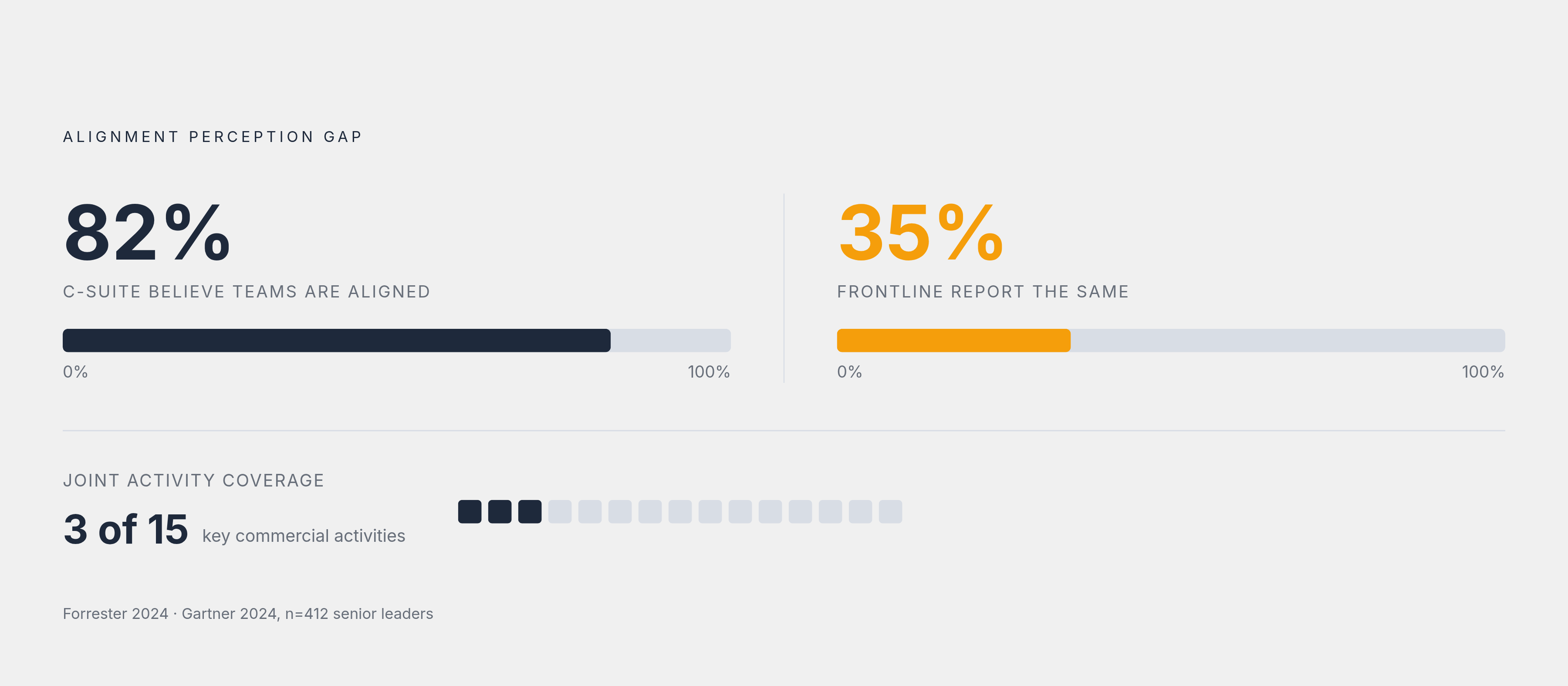
The C-suite largely does not see any of this. Forrester's 2024 research found 82% of C-level executives believe their sales and marketing teams are aligned, while 65% of frontline professionals report the opposite. Gartner's 2024 survey of 412 senior leaders adds structural evidence: sales and marketing collaborate on just 3 of 15 key commercial activities. That figure reflects a design problem, not a communication style problem, and it explains why generic alignment initiatives keep failing. The role split between sales and marketing leaks at multiple distinct points across the funnel, each requiring its own targeted fix rather than a blanket call for better cross-functional communication.
This post maps where those gaps actually occur, which function owns which stretch of the funnel, where ownership becomes contested or undefined, and what structural changes separate aligned organizations from those that keep producing the same misalignment statistics year after year.
How buyer self-direction broke the org chart
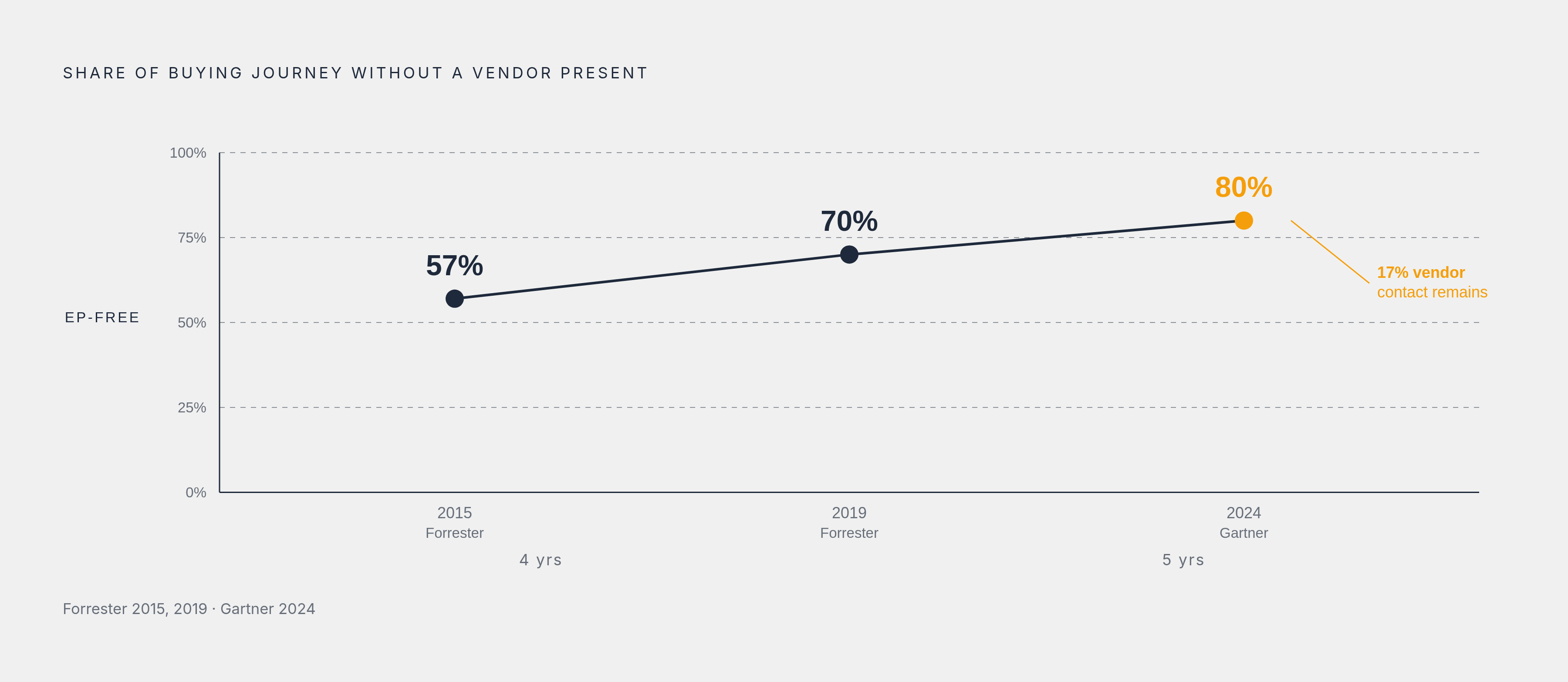
Buyers now spend only about 17% of their total buying time in direct contact with vendors, according to Gartner's 2024 research. The other 80% happens without anyone from your company present. Forrester measured self-directed buying at 57% in 2015, 70% in 2019, and Gartner's 2024 number puts it around 80%. The trend has moved in one direction for a decade.
What that means practically is that the portion of the funnel marketing once handed off early has extended much deeper into the buyer journey. Buyers are conducting their own research using tools no one on your team configured or approved, and they are building informed opinions about vendors before any sales conversation begins. Gartner's 2025 survey of 646 B2B buyers found 67% prefer a rep-free experience entirely, and 45% report using AI during a recent purchase.
The buying audience has also grown more complex. Forrester's 2024 research puts the average B2B buying group at 13 people, meaning marketing is no longer influencing a single contact but a committee with its own internal dynamics, and most lead-scoring models were never designed for that scale. Yet one thing has not changed: buyers are 1.8 times more likely to close a high-quality deal when digital self-service tools are paired with a human rep rather than either one working alone. Self-direction does not make human sellers optional; it makes the timing and definition of their role more consequential than it used to be.
What marketing owns across the funnel
Marketing covers at least three distinct functions, each owning a different stretch of the funnel.
Demand generation owns pipeline creation, including top-of-funnel awareness, inbound programs, paid acquisition, SEO, and content that gets found before anyone is actively in a buying process. Its primary job is category-level visibility and volume, ensuring the company is known before a buyer has defined a formal evaluation.
Product marketing owns messaging and positioning. It translates product capabilities into language buyers understand, produces the collateral sales is supposed to use in conversations, manages launch plans, and trains reps on competitive differentiation. This function sits at the boundary between marketing and sales, which is exactly why it is also where that boundary tends to break down.
Revenue marketing, sometimes called pipeline marketing, owns the MQL-to-opportunity zone. This includes nurture programs, lead scoring, and enforcing service-level agreements on follow-up speed. It serves as the operational bridge between what demand generation produces and what sales is willing to pick up and work.
Budget allocation reflects where marketing places its center of gravity. Lead generation claims roughly 36% of the typical B2B marketing budget, brand investment holds around 30%. Both sit upstream of direct sales activity, which is consistent with marketing's formal ownership ending at the qualified opportunity handed to sales. What the org chart does not capture, however, is that marketing content continues to influence late-stage deal progression, pricing conversations, and stakeholder management even though marketing carries no formal accountability for those stages.
What sales owns and where it needs marketing
Sales ownership divides into three layers that do not always report to the same leader.
The SDR or BDR layer owns top-of-funnel outbound prospecting, initial outreach, and early qualification. This layer floats organizationally: in some companies it reports to marketing, in others to sales, and that reporting decision changes accountability structures significantly downstream.
Account executives own discovery, demonstration, proposal, negotiation, and close. This is the core commercial motion most people picture when they think of sales.
Account management owns the post-close relationship, including retention, expansion, and renewal. Whether this sits inside sales or customer success varies by company, and the boundary between those two functions creates its own set of accountability gaps.
None of these layers operates independently of marketing. Account executives cannot work inbound leads that marketing has not generated and qualified; there is nothing to hand them. Reps depend on product marketing's competitive positioning and demo assets to build credibility in buyer conversations, and when 91% of that content goes unused, the dependency breaks in both directions: marketing produces material sales ignores, and sales improvises without the resources it was supposed to have.
Lead scoring amplifies the problem. An SDR working a cold list without marketing signal is operating without targeting information that marketing is better positioned to provide, and yet in many organizations sales is left to solve that problem independently. Gartner's 2024 data adds further context: 70% of sellers feel overwhelmed by the technology they are expected to use, and 72% feel overwhelmed by the skills now required of them. Organizations that simplify the seller's role rather than layer on additional process are 4.5 times more likely to be top performers. The honest boundary on the sales side is this: sales owns the human relationship and the close, but the quality of what it closes depends heavily on how accurate marketing's targeting was and how useful its pre-sales content turned out to be.
Three handoff zones that determine revenue outcomes
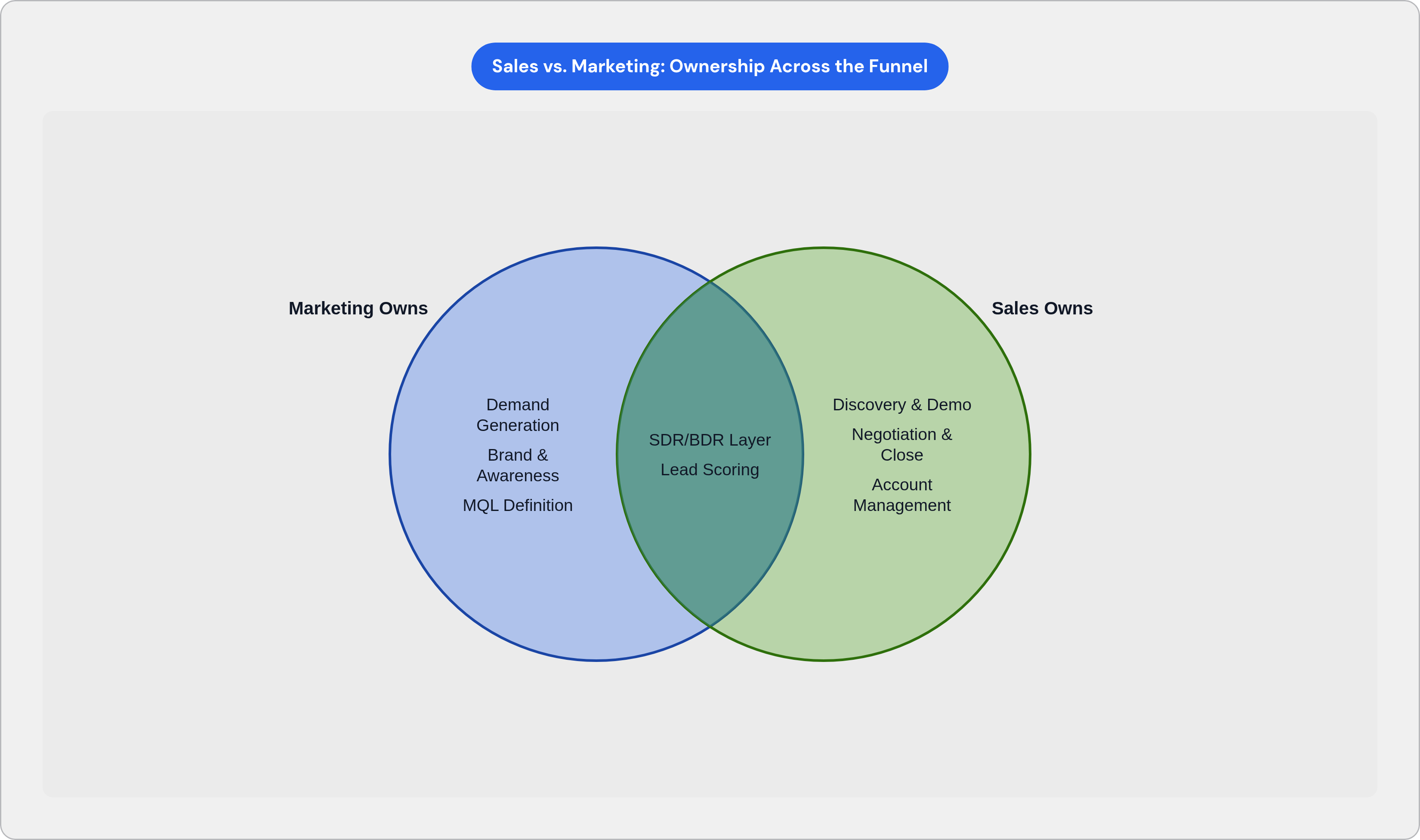
Three moments determine whether this system works or breaks down. All three are handoffs, and all three fail for the same underlying reason: ownership is not defined at the precise moment it is supposed to change hands.
Handoff zone one: demand to qualification. Marketing declares a lead an MQL. Sales disagrees about readiness. The lead goes unworked while both teams assume the other is responsible for it. The root cause is definitional: the two functions mean different things by "qualified." A shared SQL definition, agreed upon by both functions before a campaign launches, addresses this structurally in a way that increased meeting frequency does not. Gartner's 2024 findings show that 76% of mid-sized B2B companies have their CMO and sales director reporting to different superiors, and that structural separation at the leadership level produces disagreements about lead definitions at every level below it.
Handoff zone two: qualification to active pipeline. Whether SDRs report into marketing or sales determines who is accountable for what happens after a lead is handed off. SDRs in marketing tend to optimize for MQL volume. SDRs in sales tend to optimize for meetings booked. Neither orientation is inherently wrong, but leaving the choice implicit means accountability is undefined. The buying-group complexity compounds this: with an average of 13 people involved in a B2B purchase, a handoff process built around a single contact misses most of the actual decision-makers.
Handoff zone three: post-close to expansion. This handoff is typically treated as internal to sales, with marketing playing no defined role. However, aligned organizations see 36% higher customer retention and 20% higher customer lifetime value, which indicates that marketing has a measurable role in the post-sale lifecycle that most companies never assign explicitly. Customer marketing, expansion nurture, and advocacy content often belong to no one in practice, which means they receive attention inconsistently and generate results inconsistently.
The issue running through all three zones is not effort or talent. It is ownership left undefined at the exact moment a transfer needs to occur.
Why metrics and incentives make gaps structural
Marketing gets measured on MQL volume. Sales gets measured on closed revenue. When the middle of the pipeline breaks down, both teams can point to their respective dashboards and demonstrate they hit their targets. Neither function is formally accountable for the gap between those two metrics, because that gap was never assigned to anyone as a measurable outcome.
Researchers Homburg and Jensen, writing in the Journal of Marketing, identified this as a "thought worlds" problem. Sales operates on immediate revenue targets with short time horizons. Marketing operates on long-term brand and pipeline health with longer time horizons. These are not personality differences but two functions optimizing against two different planning cycles, which naturally produces different instincts about what should be prioritized in any given week.
Data quality makes the problem worse. Roughly 46% of marketers report data quality problems significant enough to hurt their own optimization work, and 28% say their data is siloed and inaccessible across teams. Sales and marketing are frequently not working from a shared picture of the buyer; they are each looking at an incomplete version and assuming the two match. Only about 30% of companies have a unified data strategy spanning their go-to-market functions, which means the majority are making ownership decisions without a shared source of truth to make them against. Changing what each function is measured on, specifically toward shared pipeline metrics rather than separate leading indicators, is the structural intervention that actually moves behavior.
What structurally aligned organizations do differently
The performance difference for aligned organizations is substantial. Forrester found aligned organizations post 2.4 times higher revenue growth and 2 times higher profitability growth. HubSpot's 2025 State of Sales report found reps at aligned companies are 103% more likely to exceed their targets. Gartner's 2025 research found organizations that prioritize alignment are almost three times more likely to beat their new client acquisition targets.
The structural practices that produce these outcomes are specific. Aligned organizations set shared revenue targets so that both functions own the same pipeline number rather than separate leading indicators pointing in roughly the same direction. They write a joint ideal customer profile and lead definition, with SQL criteria signed off by both sales leadership and marketing leadership before any campaign goes live, which closes the definitional dispute at handoff zone one before it can recur.
They resolve the SDR reporting question explicitly, and whichever team owns that layer is held accountable for conversion rate rather than activity volume alone. They put a formal service-level agreement in place on lead follow-up, with marketing committing to lead quality and sales committing to follow-up speed and documentation of lead outcomes. That agreement is the direct structural fix for the 73% of leads that currently go unworked.
They build Revenue Operations as a shared function owning data, attribution, and reporting across both sales and marketing so neither team is making decisions from a different data set. And they treat content as a feedback loop rather than a one-way delivery from marketing to sales: marketing content mapped to specific stages of the buyer journey drives conversion rates as much as 73% higher, but that mapping only works if sales provides structured feedback about where the gaps actually are.
How AI and self-direction are redrawing ownership
Sixty-seven percent of buyers prefer skipping the sales rep entirely. Forty-five percent are already using AI somewhere in a recent purchase decision. As buyers increasingly use AI tools to conduct research, build vendor shortlists, and evaluate options before any human sales conversation begins, the top and middle of the funnel are becoming more content-driven and signal-driven. Marketing's ownership window is extending further into territory that previously belonged to sales.
This creates a specific competitive risk that most revenue teams have not yet assigned an owner to: if a buyer is using AI to build a shortlist before any sales conversation occurs, then a brand that does not appear credibly in that AI-mediated research phase is eliminated before sales has any opportunity to engage. Who is responsible for ensuring the company is accurately and favorably represented in buyer self-research, including what AI tools are returning about the brand and its competitors, is a question that sits between sales and marketing with no clear owner in most organizations.
Forrester's 2024 survey of thousands of global business buyers found widespread dissatisfaction with the buying experience, which aligns with the 91% of marketing content that goes unused by sales reps. Neither function currently owns the buyer experience end to end across that self-directed research window, and it is generating measurable dissatisfaction that shows up in purchase decisions.
The model that is emerging assigns marketing a longer pre-sales window, one that now includes AI-mediated visibility as a measurable outcome, while sales owns a narrower window of human engagement that carries higher stakes because buyers arrive later in the process with more formed opinions. The handoff between those two windows requires more precision than it did when buyers spent 57% of their journey without talking to a rep, let alone 80%. Some organizations are already tracking what large language models return about their brand the same way they have long tracked search rankings, treating AI visibility as a first-class marketing metric. That is where the leading edge of marketing ownership is headed. The role split that made sense a decade ago is the wrong split for the funnel that exists now, and treating that boundary as fixed is how companies continue to generate the same misalignment outcomes year after year.