Best CRM Software for Mid-Market B2B Companies
Navigate implementation costs and platform complexity to avoid six-figure surprises.
Most CRM buying decisions get made backwards. Someone demos a platform, likes the UI, runs a quick feature comparison, checks the license price, and picks a winner. Then six months later they're staring at an implementation bill that dwarfs what they budgeted, wondering why their sales team still isn't logging calls.
The right way to pick a CRM for a mid-market B2B company is to start with what you actually are operationally, and then work forward to which platform fits that reality. Not the other way around.
Here's what "mid-market B2B" actually means in CRM terms: roughly 30 to 250 employees, multi-rep sales teams, somewhere between $10M and $150M in revenue, quota-carrying salespeople, and at least a partial RevOps function. You're too complex for the simple SMB tools that assume one salesperson and a spreadsheet. But you don't have the IT department, the implementation budget, or the change management infrastructure that a full enterprise deployment requires. You're caught in the middle, and that middle is where CRM decisions get genuinely hard.
The complexity isn't just organizational. It's in the deals themselves. Per Gartner, the average B2B deal involves around seven stakeholders, and the typical buying committee is closer to ten. Each of those people is independently consulting four or five sources of information. A deal doesn't move in a straight line. It fans out across a buying committee, hits a budget freeze, resurfaces with new stakeholders, and eventually closes (or doesn't) six to eighteen months after the first touchpoint. Your CRM has to hold all of that, not just a contact name and a close date.
On top of that, there's the integration question. Mid-market B2B companies typically run an ERP, a marketing automation platform, a customer success tool, and a billing system alongside their CRM. According to the Salesforce State of Sales report, sellers already use an average of ten tools to close a deal. And the movement right now is toward consolidation. Ninety-four percent of organizations report actively reducing their best-of-breed tools in favor of integrated platforms. Your CRM sits at the center of that consolidation effort whether you intend it to or not.
One more thing worth flagging before we get into platforms: Gartner's research now predicts that by 2030, 75% of B2B buyers will prefer sales experiences that prioritize human interaction over AI. That's a significant reversal from the earlier prediction that most B2B sales interactions would shift to digital channels by 2025. What it means practically is that CRM still has to make your reps better. It can't try to replace them.
The real cost of a CRM decision — why the license price is the smallest part
The license fee is the thing everyone fights over in the buying process. It's also the least important number in the decision.
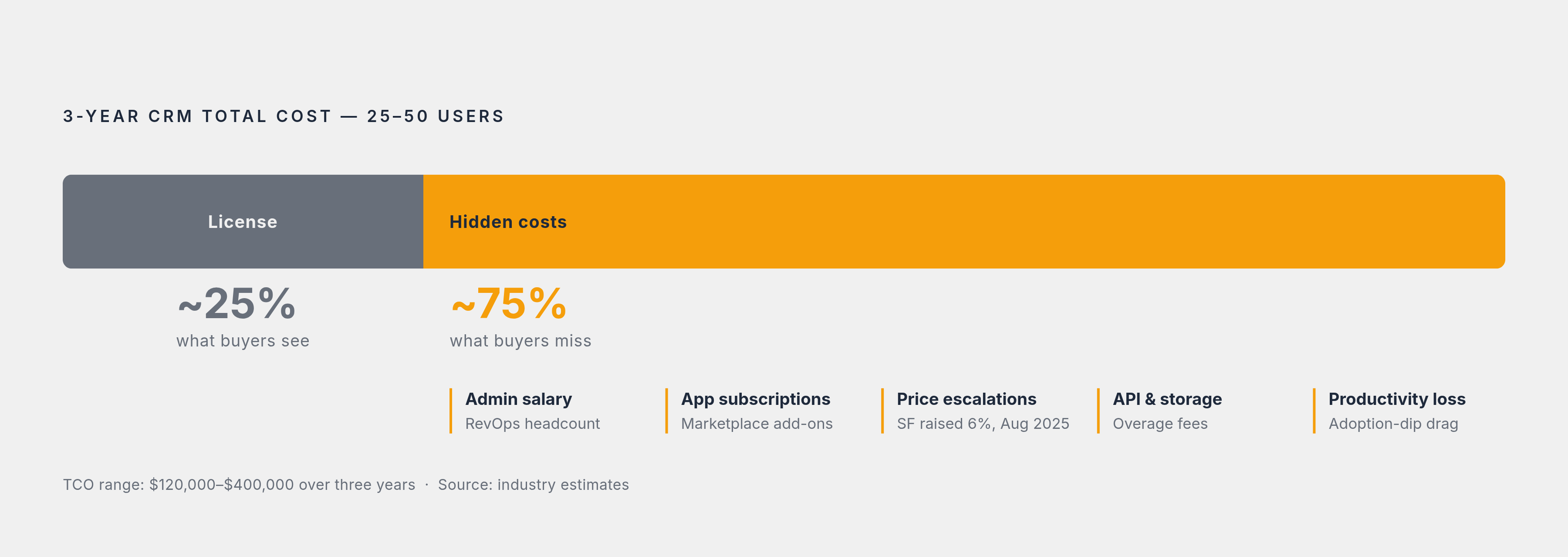
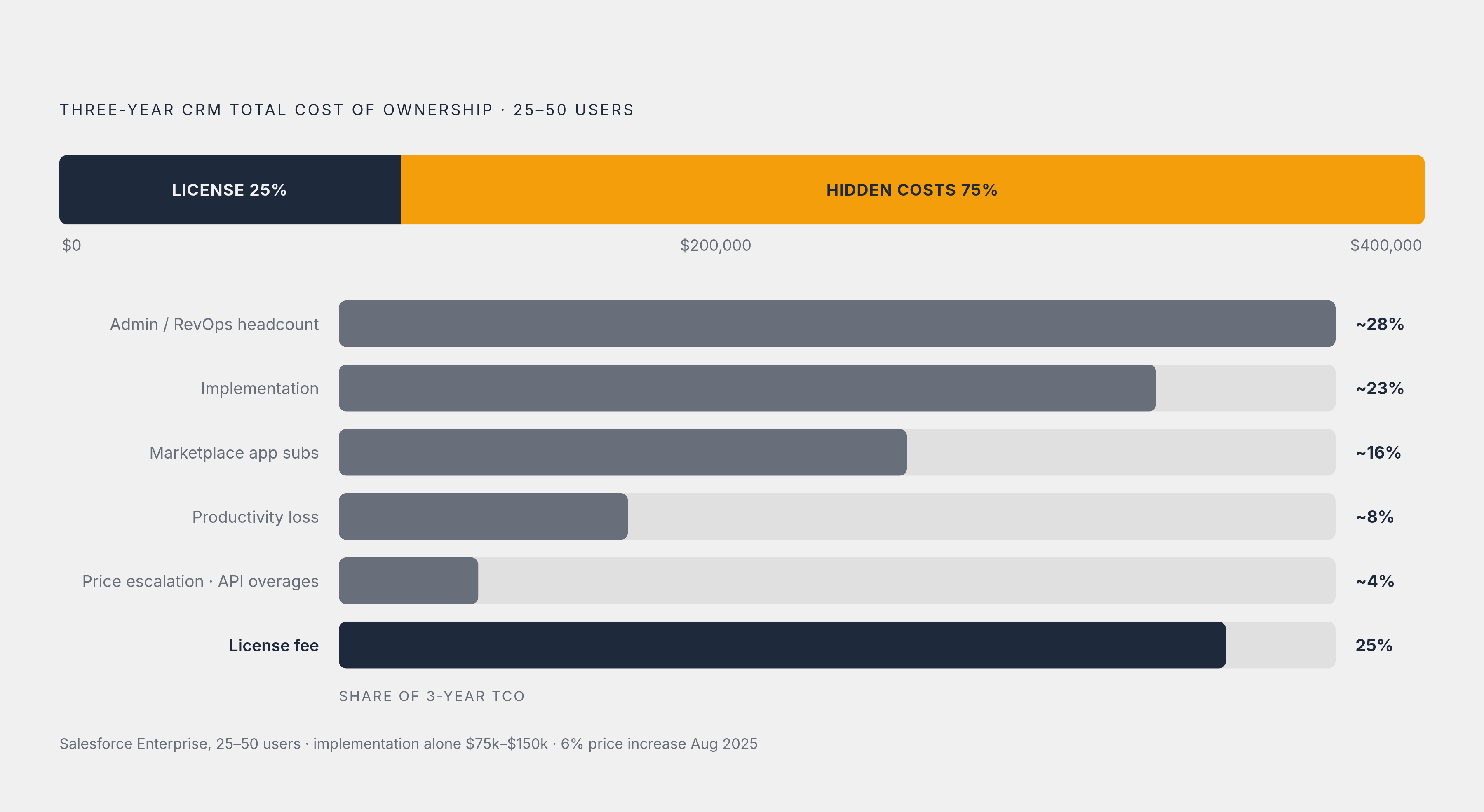
For a mid-market organization with 25 to 50 users, the three-year total cost of ownership typically runs somewhere between $120,000 and $400,000 or more, depending on platform complexity and integration needs. The license itself? Usually only 20 to 30 percent of that total. The rest is hiding in places most buyers don't look until it's too late.
Here's where the money actually goes:
- Ongoing administration. Above 50 reps, you almost always need a dedicated CRM admin or RevOps hire. That's a real salary, not a line item on a software invoice.
- Marketplace app subscriptions. These accumulate quietly. Nobody audits them. A year in, you're paying for six add-ons you half-remember approving.
- Annual license price escalations. Salesforce raised Enterprise pricing 6% in August 2025. That's not unusual. It's just usually not in the model when you sign.
- API and data storage overages. When CRM is the integration hub for a dense tech stack, you will hit usage thresholds. Eventually.
- Adoption dip productivity loss. The gap between go-live and reliable pipeline data is a real cost. It just doesn't show up on an invoice.
Integration alone deserves its own callout. Connecting a CRM to an ERP, a marketing automation platform, and a billing system can run $15,000 to $40,000 in initial implementation. That's before ongoing maintenance. APIs change. Endpoints deprecate. Authentication schemes get updated. A connection that works on launch day needs someone watching it forever.
For Salesforce specifically, implementation services for mid-market organizations routinely run $75,000 to $150,000. Many organizations end up investing between 1.5 and 3 times their annual license value just to get the thing working the way they expected it to work out of the box.
The right framing going into any platform evaluation: what will this cost to own for three years, and do we have the internal capacity to maintain it? Everything else is secondary to those two questions.
Salesforce: what it does better than anyone, and the operational commitment it requires
Salesforce has approximately 20.7% of the global CRM market and posted $37.9 billion in total revenue for fiscal year 2025. It is the dominant platform by any measure. That's not an opinion. It's just the market.
And there are genuinely good reasons for that dominance, especially in complex B2B environments:
- Sales automation and workflow depth. For non-linear deal processes, where the same opportunity moves through five different stages depending on deal size and stakeholder mix, Salesforce has the most sophisticated workflow logic available.
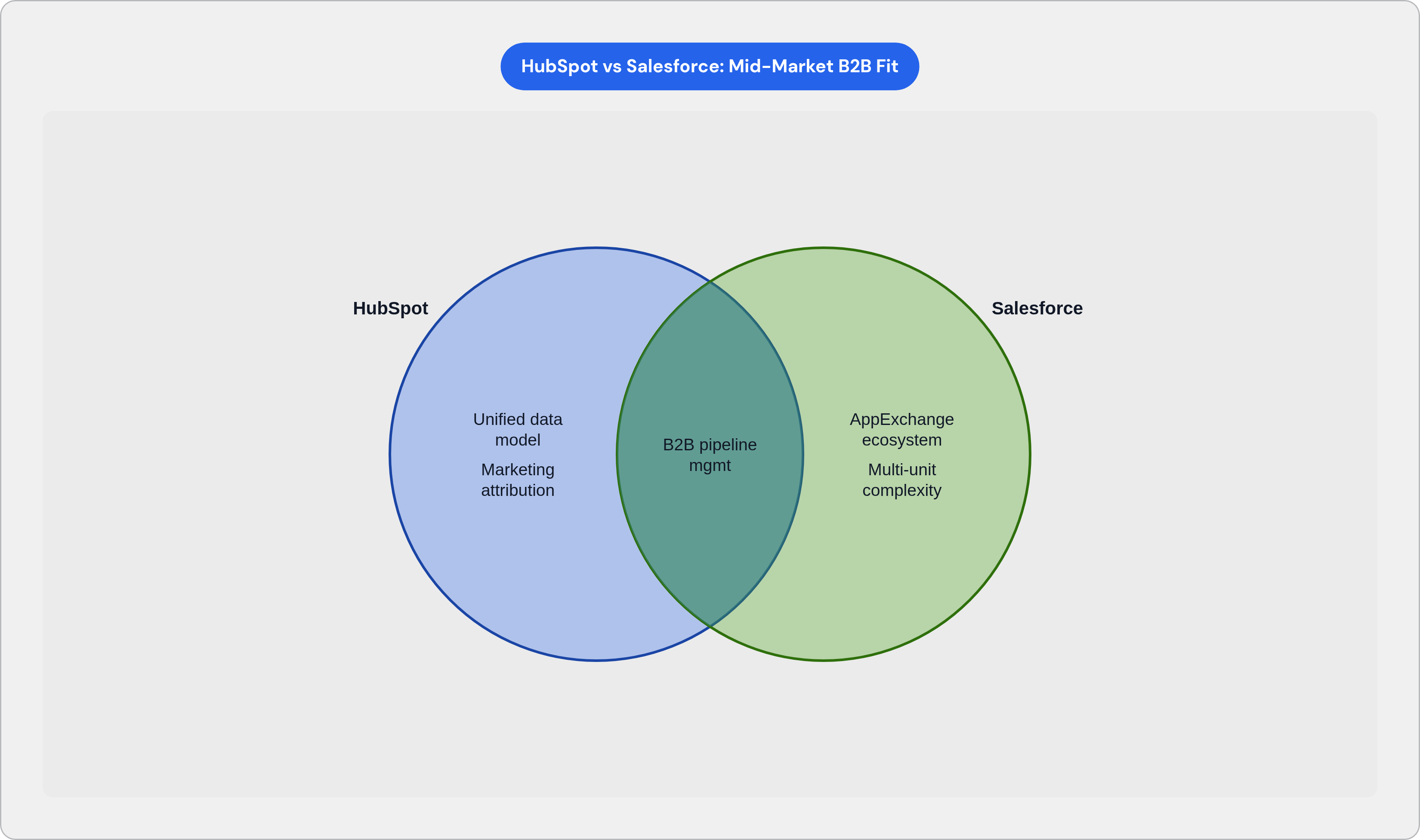
- AppExchange. Seven thousand-plus integrations. No other CRM ecosystem comes close in raw breadth.
- AI maturity. Einstein has been in market for years. Agentforce, launched more recently, extends autonomous AI capabilities further. Though as of August 2025, Agentforce capabilities are sold as add-ons starting at $125 per user per month, so budget accordingly.
- Complexity at scale. Multi-business-unit, multi-product, multi-geography, multi-channel sales motions. Salesforce handles configurations that would break most other platforms.
Now for the honest part.
Enterprise pricing sits at $175 per user per month after the August 2025 increase. Implementation routinely exceeds the first-year subscription cost. Any org above 50 reps needs a dedicated admin or a full-time consultant on retainer. The same depth and flexibility that makes Salesforce powerful at scale makes it genuinely burdensome for lean RevOps teams.
The complexity is an asset when you have the people and resources to leverage it. It's a liability when you don't.
Salesforce is the right answer for B2B SaaS companies above roughly $50M ARR, organizations running complex channel-partner sales motions, and companies with regulatory or compliance requirements that demand deep configuration. Think the Slacks, Snowflakes, and DocuSigns of the world. It was built for them.
For mid-market companies that are still growing into complexity? Salesforce is what you graduate to, not what you start with. The honest verdict is that it's the right answer when you've outgrown everything else. Not when you're trying to get ahead of outgrowing your current tool.
HubSpot: the default for marketing-led mid-market teams and what it trades off to get there
HubSpot had 299,458 paying customers as of Q1 2026 and $3.45 billion in ARR, with revenue up 23% year-over-year. That's the fastest growth of any major CRM by customer count, and it didn't happen by accident.
The structural advantage isn't really about features. It's about architecture. Marketing Hub, Sales Hub, Service Hub, Content Hub, and Data Hub all run on a single unified CRM database. They're not integrated products that talk to each other. They're the same data model. That distinction matters more than it sounds.
What that actually solves for mid-market teams:
- Marketing attribution flows directly into pipeline. No third-party sync, no data lag, no reconciliation headaches.
- Sales and marketing alignment is a built-in property of the platform, not a project you manage separately.
- Customer service cases sit on the same record as deal history. Your sales reps see what support has been dealing with before they get on a renewal call.
The AI layer, called Breeze, launched in 2025 and handles email composition, lead enrichment, prospecting research, and support workflow automation natively. No add-on pricing. That matters when you're comparing TCO.
Speaking of TCO: for a 25-person team, HubSpot Professional runs approximately $38,040 per year versus approximately $49,500 per year for Salesforce Enterprise. That's roughly an $11,500 annual gap. At 100 users, before you've even added Salesforce Marketing Cloud, that gap widens to approximately $70,000. Over three years, it's a real number.
Adoption is also worth noting. HubSpot reports an 85% adoption rate within three months and an average ROI payback of six to eight months in the mid-market segment. Adoption is the unglamorous variable that kills CRM ROI more than any other single factor.
Now for the tradeoffs, because there are real ones:
- It's less configurable for non-standard sales processes. If your deal flow doesn't fit a relatively conventional funnel model, you'll hit walls.
- Enterprise-grade workflow logic and custom object modeling are shallower than Salesforce. Not shallow in absolute terms. Shallow relative to what Salesforce can do.
- There are mandatory onboarding fees: $1,500 at Pro, $3,500 at Enterprise. Not huge, but they add to the entry cost that some buyers don't see coming.
The right profile for HubSpot is a B2B SaaS team somewhere between $1M and $50M ARR, where marketing drives a meaningful share of pipeline and the RevOps team is small. If that's you, HubSpot is where you should start the conversation.
Microsoft Dynamics 365: when your existing stack makes the CRM decision for you
Dynamics 365 is not a CRM product. It's a modular suite. Sales, Customer Service, Marketing, Field Service, Finance, Operations. All of it runs on a common data model called Microsoft Dataverse. The distinction matters because the value proposition isn't about CRM features in isolation. It's about what happens when your CRM shares a data layer with everything else.
The native integration story is real and specific:
- Microsoft 365, Teams, Outlook, SharePoint, Power BI, Azure, and LinkedIn Sales Navigator all connect without custom middleware.
- For organizations already running this stack, CRM data flows across departments as a structural property of the platform. It's not an integration project. It just works that way.
Pricing sits between $95 and $135 per user per month, versus Salesforce at $175 to $330. For organizations already anchored to Microsoft infrastructure, that's comparable enterprise capability at a meaningfully lower per-seat cost.
Dynamics 365 grew 23% in FY25 Q4 and holds approximately 5.2% of global CRM market share. Growing, but still a distant second to Salesforce in pure CRM terms.
Here's the honest limitation: for organizations that are not already running Microsoft infrastructure, the native advantage largely disappears. Without the stack integration benefit, you're evaluating Dynamics 365 on UX and standalone CRM capabilities. On those dimensions, it competes less favorably with HubSpot for most mid-market buyers.
There's also an ERP adjacency argument worth making. For mid-market companies running Dynamics 365 Finance or Business Central, using Dynamics 365 Sales means one data model across sales and finance. You're not syncing data between systems. Sales and finance are looking at the same record. That's the same structural advantage NetSuite CRM offers within its ecosystem, and it's a genuinely powerful thing when your deal cycles are long and finance visibility matters.
The short version: if you're a Microsoft shop, Dynamics 365 deserves serious evaluation. If you're not, it doesn't.
Zoho, Pipedrive, and the focused alternatives worth considering at specific stages
Not every mid-market company needs a platform that costs $50,000 a year to license and $150,000 to implement. Here's an honest look at the alternatives that belong in specific conversations.
Zoho CRM
Zoho starts at $14 per user per month. The vendor's own positioning is that it covers roughly 80% of Salesforce's functionality at roughly 15% of the cost. That framing is useful even if you take it with a grain of salt.
The genuine strengths are account-based marketing, workflow automation depth, third-party integrations, and the broader Zoho ecosystem including Analytics, Campaigns, and Desk. For teams that want a coherent stack without HubSpot's cost structure, Zoho can deliver a lot.
The real tradeoff is the experience of getting there. The UI requires patience. Onboarding is not polished. The total configuration investment is higher than it looks during a demo. You'll pay in time and setup effort what you save in license fees.
Right for: cost-sensitive mid-market teams that are willing to invest in configuration to get feature depth.
Pipedrive
Pipedrive starts at $39 per user per month. It's purpose-built for pipeline visibility and workflow automation. It doesn't try to be a marketing platform or a service platform. It just tries to be a very good sales tool.
The constraint is real: reporting capabilities are relatively basic, and customization for specialized or non-standard B2B processes has documented limits. For a straightforward sales motion, that is fine. For complex multi-stakeholder B2B deals, you'll feel the ceiling.
The bigger flag for mid-market companies is strategic. If 94% of organizations are actively consolidating their tech stacks, choosing a sales-only tool will create more integration work downstream than it saves today. That's not a reason to dismiss Pipedrive. It's a reason to be honest about where you're headed.
Freshsales
Starting at $9 per user per month, Freshsales differentiates itself on lead segmentation by industry. For mid-market B2B companies with a well-defined ideal customer profile across a handful of verticals, that's a genuinely useful capability. It's a niche fit, but a real one.
NetSuite CRM
This one isn't a standalone CRM at all. It's a module within the NetSuite ERP platform. Which means the only people who should be evaluating it are people already running NetSuite ERP.
If that's you, the value is real. Sales reps see open opportunities, payment history, invoices, support cases, order backlog, and contract renewal dates in one record. No sync, no delay, no "the finance team has different numbers than we do." One record.
For mid-market companies already on NetSuite, this is often the lowest-friction path to CRM data that actually reflects the full customer relationship.
Attio
Attio is the outlier in this list. Pricing sits at $34 per seat per month at the Plus tier and $69 at Pro. It was built with a database-flexible object model, AI-native enrichment, and deep Google Workspace and Slack integration.
It's designed for product-led growth operating models and early-to-mid-stage B2B SaaS teams that find traditional CRM object models too rigid. If you've ever tried to force a non-standard sales motion into Salesforce's default objects and wanted to flip a table, Attio was built for you. Not for everyone. But genuinely worth knowing about if you fit the profile.
How integration requirements should shape the CRM decision before feature comparisons begin
Most CRM evaluations start with features. They should start with integrations. Not as an afterthought, but as the first filter.
Here's why. Mid-market B2B companies typically have an ERP or financial system, a marketing automation platform, a customer success tool, a billing and payments system, and, for SaaS companies, increasingly some form of product usage data piped in alongside all of it. The CRM doesn't just touch those systems. In most organizations, it becomes the connective tissue between them.
Connecting CRM to ERP, marketing automation, and billing alone can run $15,000 to $40,000 in initial implementation costs. That's before you account for what happens over the following three years.
And here's the thing most teams underestimate: APIs change. Endpoints get deprecated. Authentication schemes get updated. Rate limits shift. A connection that works perfectly on launch day is not a connection that runs itself forever. Someone owns the maintenance of that integration. If you don't know who that is before you sign, you'll find out the hard way.
How this should affect platform selection:
- Native integrations reduce surface area. Dynamics 365 within a Microsoft stack, NetSuite CRM within a NetSuite ERP environment, HubSpot's internal hub model — these reduce the amount of custom API work you need, and the amount of custom API work you need to maintain.
- AppExchange breadth doesn't solve the maintenance problem. Salesforce's 7,000-plus connectors solve the availability question. They don't solve the ongoing ownership question. You still need someone watching those connections.
- Extensible-but-not-pre-connected platforms shift the burden to you. Some platforms position themselves as highly flexible and open. That's true. It also means your internal engineering or RevOps team carries the integration load, indefinitely.
The evaluation question most teams skip entirely is this: not "does it integrate with X?" but "who owns the maintenance of that integration when the vendor changes their API in 18 months?"
Pre-built, managed connectors (whether native to the CRM or provided through embedded integration infrastructure) reduce both time-to-market for new connections and the operational risk that comes from API drift over time. That distinction is worth more than almost any feature comparison on a sales demo.
A decision framework for mapping your specific situation to the right platform
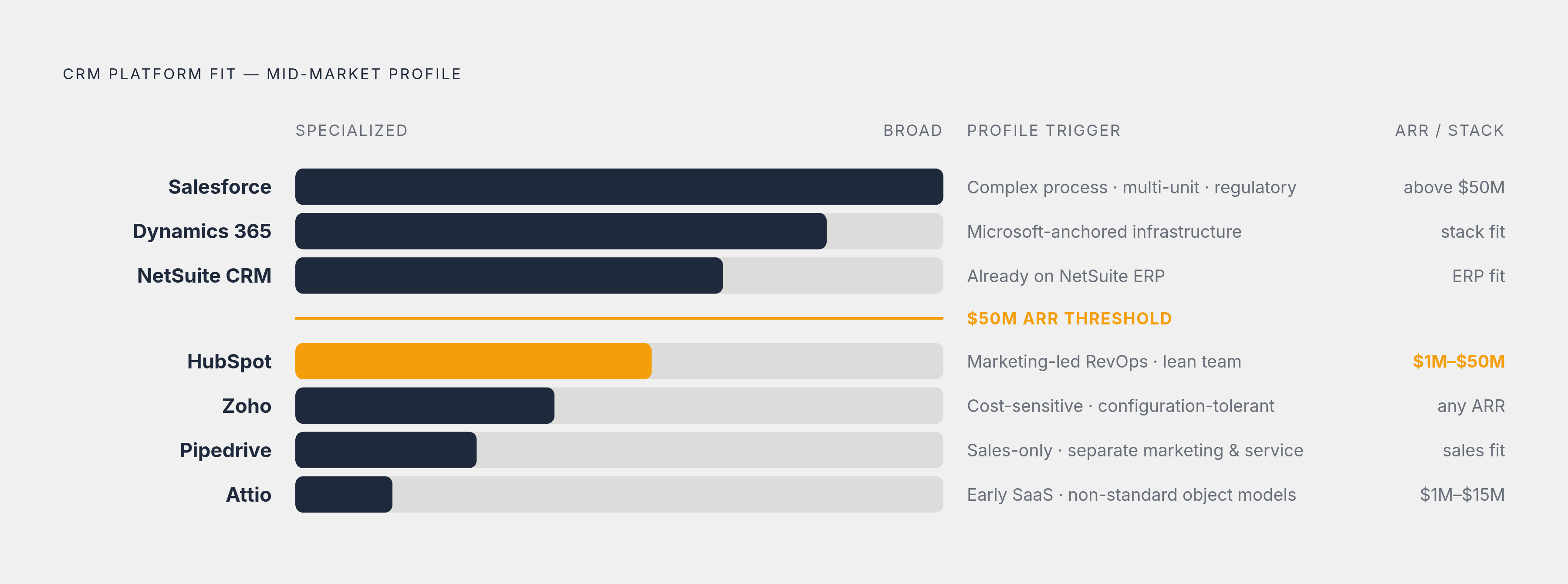
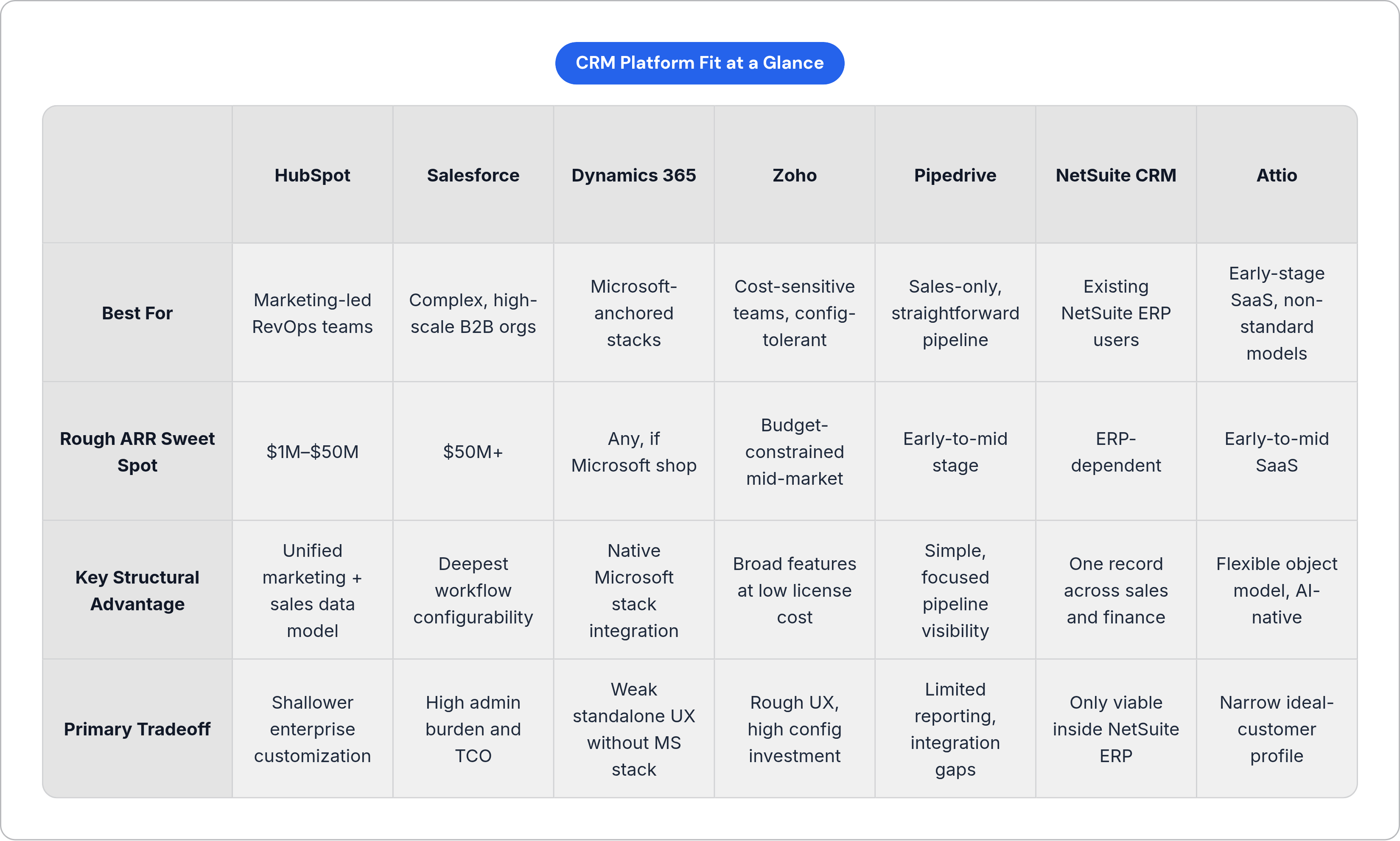
The shorthand that actually holds up across most mid-market B2B situations:
- HubSpot for marketing-led, integrated RevOps, roughly $1M to $50M ARR, lean team
- Salesforce for complex process, scale above $50M ARR, multi-unit or regulatory requirements
- Dynamics 365 for Microsoft-anchored infrastructure
- Zoho for cost sensitivity with configuration tolerance
- NetSuite CRM when you're already on NetSuite ERP
- Pipedrive for sales-team-only use cases with separate marketing and service tooling
- Attio for early-to-mid-stage SaaS teams that find traditional CRM object models too constraining
That shorthand is useful, but it glosses over the six variables that actually determine the right answer for your specific situation:
1. Where does pipeline come from? If marketing generates most of your pipeline and you need closed-loop attribution between campaigns and revenue, a unified platform like HubSpot has a structural advantage. If pipeline is primarily outbound or partner-driven, that advantage shrinks.
2. How non-standard is your sales process? If your deals move in genuinely unusual ways — multiple parallel tracks, complex approval chains, custom pricing logic — you need Salesforce-level configurability. If your process is more conventional, you're paying for complexity you won't use.
3. What does your tech stack already look like? This is the integration question from the previous section, applied directly to the decision. Native integrations are worth real money over three years. If you're already a Microsoft shop, Dynamics 365 starts with a structural cost advantage before you've compared a single feature.
4. What's your internal capacity for administration and maintenance? Salesforce without a dedicated admin is a liability, not an asset. HubSpot can run leaner. Zoho requires configuration investment upfront. Be honest about who in your organization will own this after the implementation team leaves.
5. What's your three-year growth trajectory? If you're at $15M ARR today and plan to be at $80M in three years, making a platform decision for where you are now will mean a painful migration at exactly the wrong moment. The cost of switching CRMs mid-growth is rarely modeled but always real.
6. What does your deal complexity actually demand? Go back to the multi-stakeholder reality at the top of this piece. Average B2B deals involve multiple buying committee members, each consulting independent sources. If your deals match that complexity, you need account-level visibility, multi-thread opportunity tracking, and workflow logic that reflects how deals actually move. Not every platform delivers that equally. Know which one you're buying before you sign.
The last thing worth saying is this: no CRM decision is permanent, but they're all expensive to reverse. The time you spend mapping your operational reality to the right platform before you sign is the cheapest time you'll spend in this process.