Benefits of CRM for B2B Sales and Revenue Operations
A unified CRM keeps complex B2B deals on track when reps leave and buyers stay hidden.
B2B deals are structurally complex. Buying cycles stretch past a year, six to ten decision makers are involved per deal, and buyers move across ten different channels before they talk to a rep. That's a full coordination problem — like trying to conduct an orchestra where half the musicians can't see the conductor and the other half are reading different sheet music. Most sales teams are trying to solve it with a combination of human memory, spreadsheets, and intuition.
Here's what that looks like in practice. A rep gets promoted or leaves. Half the deal context walks out the door with them. A new AE takes over an account with no real record of what was promised, what objections came up, or which stakeholder actually controls the budget. Meanwhile, the buyer has already talked to three different people at your company and is starting to wonder if anyone there actually communicates.
CRM exists specifically for this. One place where every contact, every interaction, and every signal across a long and messy buying journey gets stored and stays accessible. Not just to the rep who logged it, but to every person who might touch that deal. The SDR, the AE, the solutions engineer, the customer success manager. Everyone sees the same record.
The influence map piece is where it really earns its keep. You're not just tracking one lead. You're tracking who's involved, what each person cares about, where they sit in the internal approval process, and what objections have already come up. That either lives in the CRM or it lives in someone's head, which means it's one resignation away from being gone.
None of this works if the data is bad. And CRM data quality is a widespread problem. Around three-quarters of CRM users report that less than half of their organization's data is actually accurate and complete. The reason isn't carelessness. It's that manual data entry is a pain, and if logging an activity takes ten steps, reps won't do it consistently. Fix the friction first. Email sync, automatic call logging, background activity tracking that doesn't require anyone to remember to do anything. Better data follows almost automatically once you remove the compliance burden.
Unified data is the prerequisite for everything that follows.
CRM's real impact on rep productivity
Reps spend roughly 40% of their workweek actually selling. The other 60% goes to manual data entry, internal meetings, and prep work that shouldn't take as long as it does. That's not a discipline problem or a motivation problem. It's a systems problem, and it's a fixable one.
CRM automation goes after that 60% directly. The time savings from eliminating manual data entry and duplicate work alone can add up to five to ten hours per rep per week. Across a team of twenty reps over a full year, that's effectively adding headcount without the headcount cost.
The benefit isn't just that reps get time back. It's what they do with that time. When a rep walks into a meeting with the full CRM context, prior conversations, stakeholder roles, open objections, and previous proposals, they show up prepared. That matters because over 80% of B2B buyers say sales reps arrive to meetings unprepared, and nearly half will dismiss a call immediately if the rep hasn't done basic homework. CRM doesn't just speed things up. It raises the quality of every interaction.
The output numbers reflect this. Sales cycles shorten when automation handles follow-up triggers and handoff tasks without requiring a human to remember. Revenue per rep goes up. And reps who are actually using the tool well tend to notice the difference fast, which is usually what finally gets skeptical teammates to adopt it.
How centralized data transforms pipeline forecasting
Without structured tracking, a B2B pipeline is genuinely hard to read. You've got deals running 84 days on the short end, six to ten stakeholders per opportunity, and interactions scattered across phone, email, LinkedIn, and however many other channels your buyers prefer. A spreadsheet with deal stages tells you almost nothing about whether a deal is actually moving. It just tells you where someone put it the last time they updated it, which might have been three weeks ago.
CRM changes what you're actually looking at. Deal velocity. Recency of engagement with key stakeholders. Whether you have coverage gaps across the buying committee. Managers go from coaching on gut feel to coaching on something real.
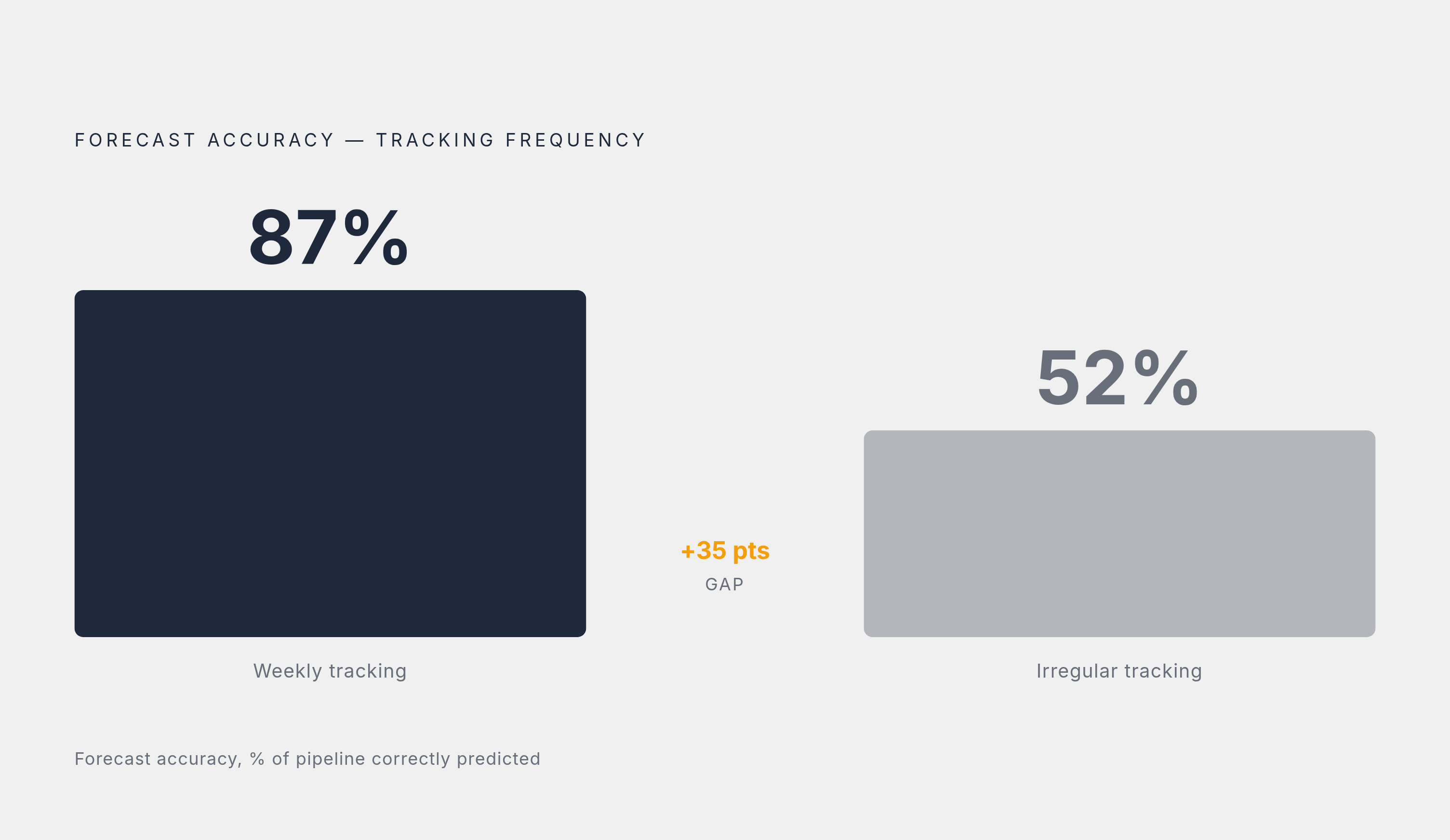
Teams that track pipeline on a weekly basis hit around 87% forecast accuracy. Teams that track irregularly land around 52%. That 35-point gap isn't about having better instincts. It's about having a process and data that actually supports it. CRM systems improve forecasting accuracy by an average of 42%, and the downstream effects are meaningful. Businesses using CRM are substantially more likely to exceed their sales goals, and win rates improve considerably with integrated systems.
Forecasting is only as good as the information feeding it. Centralized data makes the information trustworthy. The rest follows from that.
CRM as the RevOps shared system of record
RevOps as a model has grown fast because the alternative is genuinely expensive. Poor alignment between marketing and sales alone drives customer acquisition costs up and stretches sales cycles out. Nearly all RevOps professionals will tell you that process gaps cost revenue.
RevOps as a philosophy only works if there's shared infrastructure underneath it. You can hold all the alignment meetings you want, but if marketing is working off one dataset and sales is working off another and customer success is working off a third, you're not actually aligned. You're just synchronized in your confusion, with three teams rowing hard in three different directions.
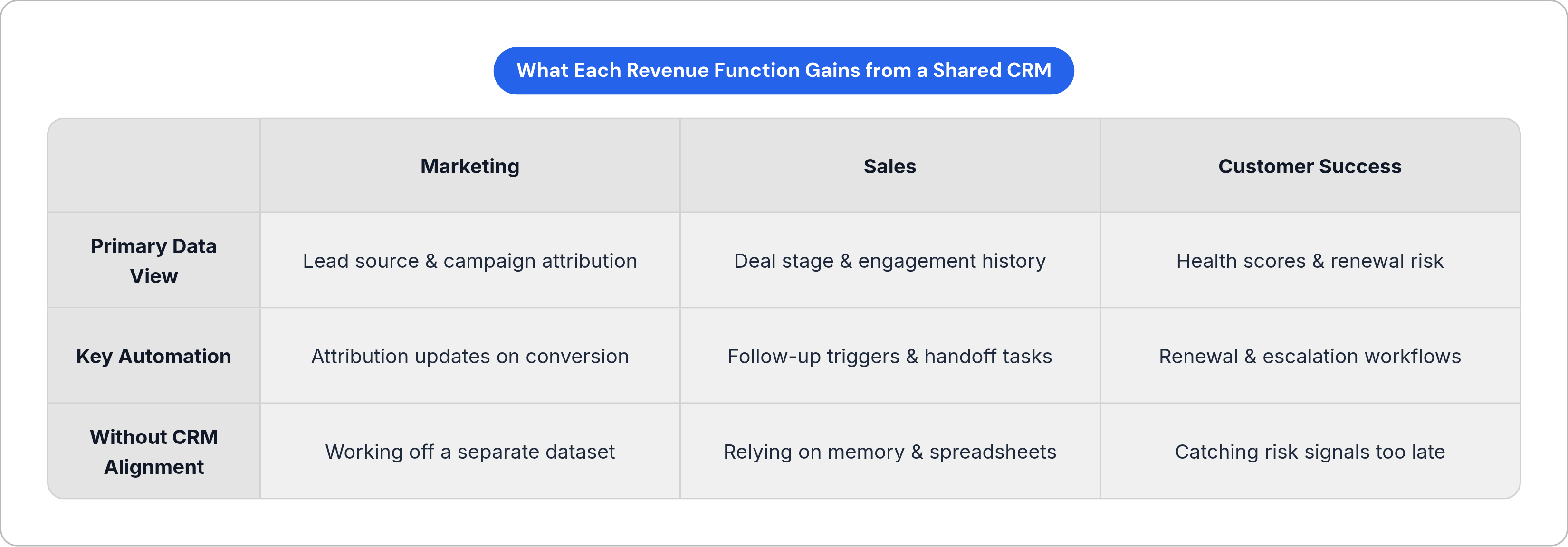
CRM is what makes the philosophy operational. Marketing sees lead source and campaign attribution. Sales sees deal stage and engagement history. Customer success sees health scores and renewal risk. All in the same system. Handoffs stop being something someone has to remember to do and become event-triggered. Deal closes, CS gets notified automatically. Trial converts, marketing attribution updates without anyone sending an email chain to confirm it.
The business results behind aligned RevOps functions are documented. Organizations running this model see more revenue growth, higher profitability, and are more likely to exceed revenue targets compared to siloed teams. Gartner projected that 75% of the world's highest-growth companies would adopt RevOps by 2025, not because it sounds elegant on a slide, but because it works.
The CRM is the operational core of the whole revenue engine. Every automation, every AI agent, every dashboard reads from it and writes to it. The quality of your CRM data is the quality of your RevOps function, which is exactly why 38% of RevOps leaders call poor data accuracy their top barrier to growth.
How CRM improves retention and reduces CAC
Keeping a customer costs somewhere between five and twenty-five times less than winning a new one. Small improvements in retention have outsized effects on profitability because you're not paying acquisition cost on every renewal.
CRM is how you act on this structurally. Companies that use CRM effectively for existing customer engagement see meaningful increases in retention rates, not because the software is charming, but because it gives customer success and account teams the full interaction history they need to catch risk signals before a customer is already gone. Declining usage, missed check-ins, unresolved support tickets. Those patterns show up in the data before they show up in a cancellation request.
The practical power comes from automation. Renewal triggers, health score thresholds, escalation workflows. These run without depending on a rep noticing that something feels off. You systematize what used to be relationship management by instinct, and that instinct was always inconsistent anyway.
On the personalization side, the lift is real and it compounds. Eighty percent of consumers are more likely to buy from companies that offer personalized experiences. Personalized email campaigns built on CRM data show higher click-through rates than generic ones. Across an entire customer base over a full year, that kind of consistent lift adds up quickly.
The downstream CAC reduction is also documented. A significant majority of businesses report lower customer acquisition costs after CRM implementation. That's the return that actually changes the unit economics.
AI and automation extending CRM's core benefits
AI inside CRM is mainstream now. The majority of companies are already running CRM systems with generative AI or AI-driven features built in.
For pipeline management specifically, the additions are genuinely practical. Predictive lead scoring surfaces which accounts are most likely to convert based on behavioral signals, so reps aren't just working from gut feel and whoever replied to the last email. Real-time deal risk alerts flag stalled opportunities before they quietly die. AI-driven next best action recommendations pull from patterns in closed-won deals to suggest what should actually happen next on any given opportunity.
Across the funnel, automation is handling more of the repetitive work: lead nurturing, customer communications, campaign analytics. In March 2026, Salesforce launched Agentforce Contact Center, which blends CRM with AI agents and telephony into a single workflow. CRM is no longer just where reps log what happened. It's becoming the coordination layer where AI and human work happen together in real time.
All of it is only as reliable as the data flowing into it. AI outputs are downstream of data quality, always. That means the CRM's connections to marketing automation, support platforms, and product usage data need to stay current and accurate. About one in five businesses cite integration with other tools as a top implementation struggle. That number will matter more as AI takes on a bigger role, not less.
Why CRM implementations so often fall short
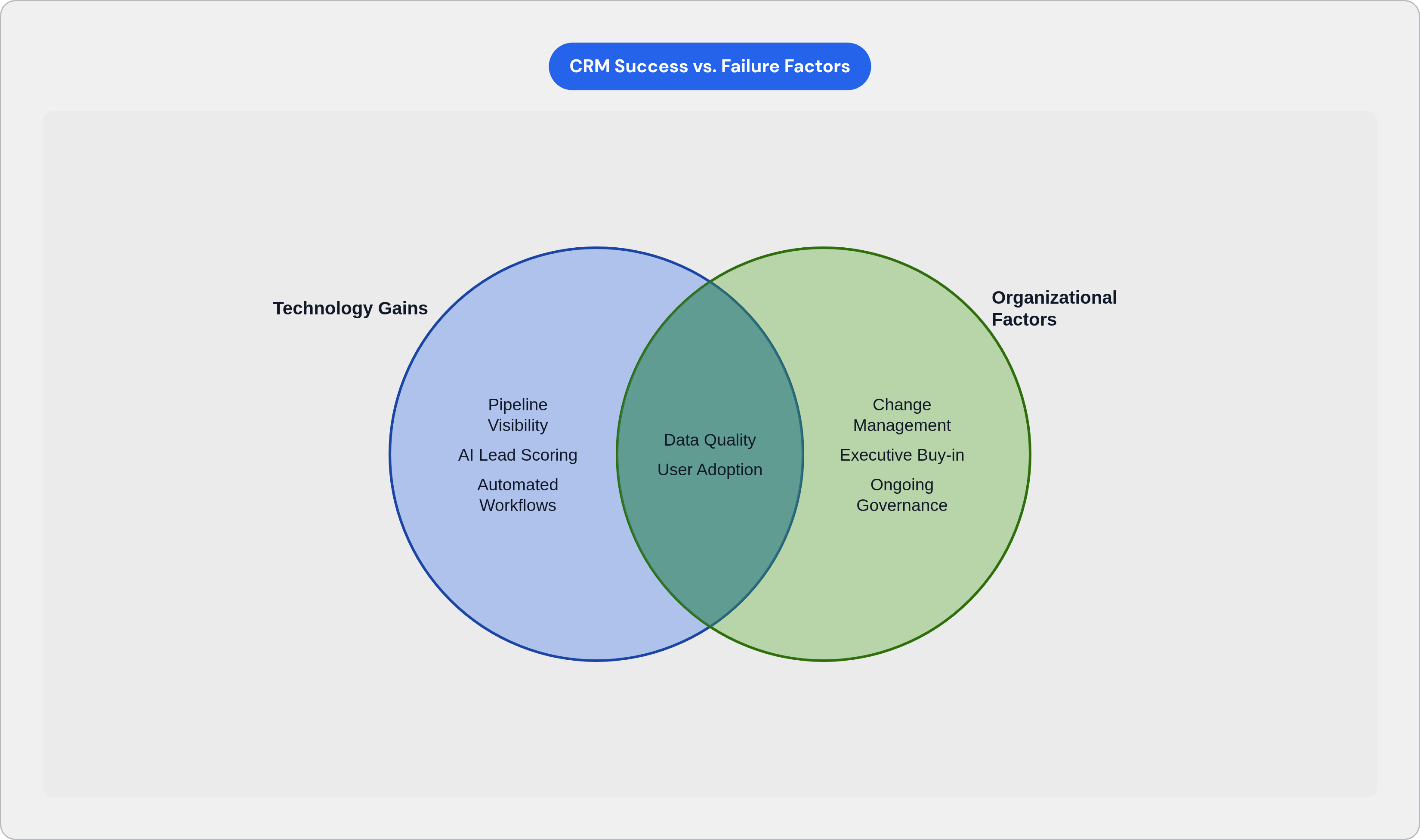
Over half of CRM implementations fail to hit their planned objectives. Over 60% of those failures come from people problems, not software problems. Resistance to change. Inadequate training. Executives who said they were committed and then stopped looking at the dashboards.
The pattern is remarkably consistent. A company buys the tool, configures it to reflect how the business works today (which is often already broken), runs a training session that nobody took seriously, and then wonders three months later why adoption is low and data quality is degrading. Reps experience it as more administrative burden. Managers don't enforce it. The value proposition collapses before it ever really started.
What actually works looks like the opposite of that. You start with the process, not the platform. You design for low-friction data capture from the beginning, not as an afterthought. You tie executive reporting and team accountability to what's in the CRM, so it's not optional. And you treat adoption as an ongoing management behavior, reinforced consistently, rather than a launch event you check off the list once.
Failed implementations typically cost 30 to 50% more than budgeted and burn six to eighteen months of productivity. Then organizations often have to restart, which can effectively double the total cost.
The benefits described throughout this piece are real and documented across thousands of companies. But they're not automatic. The gap between teams that get transformational results and teams that end up with an expensive contact database is almost entirely explained by how seriously they took the implementation, the training, and the ongoing governance. The tool is capable. Capturing that capability is an organizational discipline problem, not a software problem.