How to Improve Customer Interaction Response Quality
Consistency, not talent, determines whether customers get reliable answers across every interaction.

Customer service quality has a consistency problem, not a talent problem. Forrester's Global Customer Experience Index 2025 found that only 3% of companies qualify as genuinely customer-obsessed. That's not a rounding error. That's a system failure happening at scale, across an entire industry, in plain sight.
Here's what that gap looks like on the ground: same issue, different agents, different resolutions. Not because anyone's careless. Because the infrastructure that should make good answers repeatable simply isn't there. When quality depends on one agent's judgment call instead of a system, you get exactly what you'd expect: a new hire and a ten-year veteran producing wildly different outcomes for the same customer complaint. That's not a training problem you fix with a pep talk. That's a design flaw.
The stakes are lopsided, too. Bain & Company research shows that lifting customer retention by just 5% can grow profits by up to 95%. Meanwhile, PwC found that one in three consumers will walk away from a brand they genuinely loved after a single bad experience. Loyalty builds slowly and evaporates fast, which means consistency isn't a nice-to-have. It's the whole game.
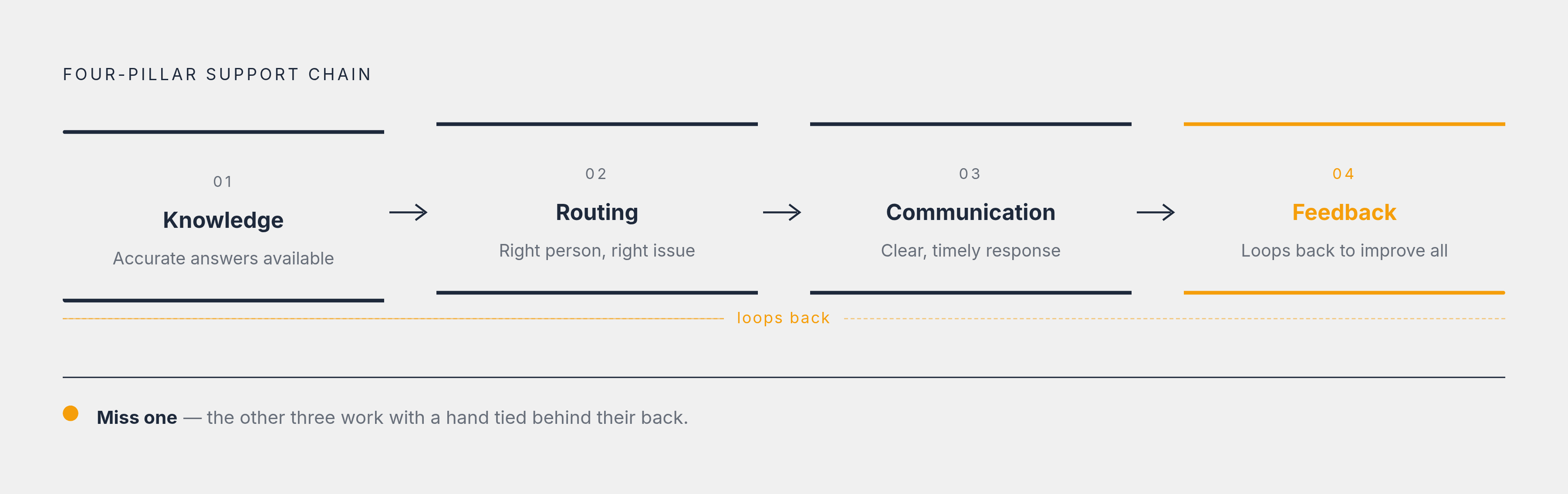
So the real question isn't "how do we get better agents." It's "what system produces good answers regardless of who's answering." That system has four parts: knowledge, routing, communication, and feedback. Miss one, and the other three are undermined.
What breaks when the knowledge layer fails
An agent can only sound confident when they actually know something. Knowledge gaps don't just produce wrong answers. They produce hedging, unnecessary escalations, and the dreaded callback, where a customer has to explain their problem all over again to a different person. Every one of those outcomes signals a system that isn't working and erodes customer trust.
A knowledge base requires active maintenance. Products change, policies change, pricing changes, and if the documentation doesn't move with it, that knowledge base stops being useful and starts being a liability. An agent who confidently repeats an outdated return policy creates a promise the company can't keep.
The fix is an internal FAQ and a searchable knowledge base, paired with refresh cycles triggered whenever something changes upstream. That pairing matters more than either piece alone. A knowledge base without refresh cycles becomes a document nobody trusts, and refresh cycles without a searchable base mean nobody can find the update anyway.
Agents making real-time decisions during a live call need documentation that is organized, current, and easy to search. A well-maintained knowledge base doesn't just help agents; it can power customer-facing self-service portals, cutting inbound volume before a human ever picks up the phone. It also lets a brand-new hire give the exact same answer as a senior agent. That's what scaling best practices actually means: documented knowledge doing its job. Without it, agents improvise, answers drift apart, and QA has no fixed benchmark left to measure anyone against.
Routing gets knowledge to the right interaction
Knowledge only matters if it reaches the right conversation at the right moment. Routing is the connection between the two, and when it fails, all the work put into training and documentation goes to waste on a misdirected ticket.
Consider a common scenario: a customer starts in a chatbot and gets transferred to a live agent. That handoff only works if the agent picks up with full context already loaded, with no "can you repeat the issue" required. Omnichannel support isn't really about covering every channel. It's about preserving context as the customer moves between them.
A CRM is what makes that possible: one shared record of interaction history, purchase history, and channel history, so every agent sees the same customer no matter how they contacted support. Without it, each channel becomes its own island, and the customer is left carrying information between them.
AI copilots and automated routing handle repetitive volume so human agents aren't stuck answering "where's my order" dozens of times an hour. That frees people up for the complex, emotionally charged interactions where automation falls short. The distinction matters: automation triages so the right cases land in the right hands. Simple inquiries go to self-service or bots. Complex and sensitive ones go to the most prepared human available.
This only holds up with regular testing at the integration points. Does a ticket opened by email actually appear when the customer calls in for a follow-up? Integration failures at that seam are what quietly break the omnichannel experience, usually invisibly, until a customer complains about repeating themselves for the third time. Cross-training agents to work across multiple channels while maintaining the same quality standard on each ensures the system doesn't collapse the moment one channel gets busy.
Communication skills that determine response quality
Active listening means complete concentration on what a customer says, aimed at understanding the actual issue, not just processing the words as they arrive. That distinction between understanding and processing is the difference between a resolution and a customer who has to explain themselves twice.
This is trainable, not some innate gift certain agents are simply born with.
Paraphrase and summarize: "So if I'm understanding correctly, the main issue is…" confirms the agent was listening and catches misunderstandings before they turn into a wasted exchange.
Open-ended questions: "Can you walk me through what happened when you tried to log in?" pulls out context instead of shutting the conversation down with a yes-or-no.
Empathetic acknowledgment: "I can see how frustrating this is" validates the emotion before moving to the fix, which changes how the whole interaction feels for the customer.
Reframing "we can't do that" into "here's what we can do" isn't about sounding polite for its own sake. Customers remember how they were spoken to at least as much as they remember what got fixed. Clarity matters just as much. Leading with the most important information and cutting jargon reduces follow-up contacts and repeat tickets.
Zappos is a useful case study here. Agents were empowered to spend as much time as needed genuinely connecting with a customer, and what got measured was personal service level and emotional connection through something called a Happiness Experience Form, not call duration. A call center measuring agents by how fast they hang up produces a fundamentally different customer experience.
First Contact Resolution is what happens when knowledge and communication align. FCR isn't just a positive customer experience metric; it cuts operational cost at the same time it reduces customer effort. Organizations that invest in deep agent training aim to close even complicated inquiries in one interaction, with no transfers required.
These skills don't show up naturally under pressure. They get built through role-play: simulating a late order, a broken feature, or an angry customer and practicing the empathetic response before a real situation demands it.
Feedback loops that actually change agent behavior
Feedback without a loop is just data collection. A loop means the insight travels somewhere: back into training, back into the knowledge base, back into routing decisions.
The instruments matter and are not interchangeable. Post-interaction CSAT and NPS surveys, social listening, and direct feedback forms each capture a different signal at a different point in the customer's journey. Relying on just one means missing the signals the others are designed to catch.
Uber's post-ride rating system is a useful example of a fast feedback loop: immediate, star-based feedback tied to ongoing performance, tight enough that improvement happens continuously rather than in a quarterly review. Airbnb runs a double-blind review system that encourages hosts and guests to hold each other accountable. Neither system is perfect, but both demonstrate that transparency functions as a quality mechanism on its own.
Quality assurance tooling such as ticket scoring, sentiment analysis, and coaching workflows turns raw feedback into something an individual agent can act on, rather than a team-wide average that tells nobody anything specific. Specificity is what drives improvement: "agents are paraphrasing less often on email than on chat" is a coaching target. "CSAT dropped two points" is not.
None of it matters if agents lack the authority to act on what the feedback reveals. A loop that surfaces a problem an agent isn't empowered to fix doesn't develop anyone; it demoralizes them. When authority and feedback are aligned, the loop matures into something more valuable: spotting patterns early enough to solve a problem before a customer ever has to report it. That shift from reactive to anticipatory is the point of building the loop in the first place.
KPIs that reveal system health versus hide it
CSAT, NPS, First Contact Resolution rate, first response time, and resolution time each answer a different question about a different part of the system. None of them tells the whole story alone.
FCR is the closest thing to a single metric that reflects overall system health, since it only looks good when knowledge, routing, communication, and agent authority are all working together. A low FCR rate is rarely one agent having a bad week. It usually means the system is failing somewhere upstream.
Response time gets more attention than it deserves. A fast reply that sends a customer through three follow-up contacts scores worse in the customer's mind than a slightly slower answer that resolves the issue completely the first time. Speed matters less than resolution.
The financial case for measurement is clear. Bain & Company research found that businesses with the highest customer satisfaction scores return double the shareholder value and triple the growth of their peers. That's a business strategy finding, not just a customer service one.
A raw CSAT score with no segmentation by channel, agent, issue type, or customer tenure conceals exactly where things are breaking. A solid aggregate number can sit on top of a broken routing layer or a knowledge gap in one specific product line without anyone noticing. Forrester's Global Customer Experience Index 2025 identifies a consistent gap between intended and actual customer experience, a gap that channel-level and issue-type breakdowns are far better positioned to reveal than any topline number. The actual decisions get made at the segmented level, not at the aggregate.
QA tools including ticket scoring and sentiment analysis bridge the gap between a single conversation and the pattern sitting behind hundreds of similar ones. Treated correctly, QA is not a punitive audit. It's the feedback mechanism telling the knowledge layer and training program exactly what to fix next.
Measurement cadence matters as well. Weekly coaching on response quality, monthly review of FCR broken out by issue type, and quarterly assessment of routing performance keep corrections timely. Delayed corrections arrive too late to matter.
One final risk worth flagging: a metric that looks clean because nothing is being logged is not the same as a metric that looks clean because issues are genuinely being resolved. A dashboard built on incomplete data produces flawed improvement decisions, because every conclusion drawn from that data is built on a foundation that was never reliable to begin with.