Customer Relations Skills for Account Managers
Relationship skills determine retention more than product knowledge.
Account managers own one job: keep the customers you already have, and grow them. The focus stays on sitting as the one point of contact for a portfolio and making sure the relationship doesn't quietly rot while revenue is supposed to be climbing, rather than chasing new logos or cold-calling prospects who've never heard of your company. The U.S. Bureau of Labor Statistics projects 6% growth in marketing and advertising management roles between 2024 and 2034, adding roughly 36,400 jobs. Companies figured out a while back that keeping a customer costs less than replacing one, and somebody has to own that math, and that somebody is the account manager.
Because the job sits so close to revenue, the interpersonal side carries the same weight as the technical side of the work. A missed deadline shows up on a spreadsheet where somebody can catch it, while a client who feels unheard shows up on a cancellation notice, and by then you're not fixing anything.
Why relationship skill determines retention
Most account managers know the product cold, and that's the floor, not the differentiator. Clients assume you know what you're selling, and nobody has ever renewed a contract because someone described a feature accurately.
What clients track, whether they'd phrase it this way or not, is whether they feel heard and put first. CareerTrainer.ai reported in May 2026 that 68% of customers leave a company because they sense indifference, more than price and product failure combined.
Skill gaps in this part of the job don't show up in a performance review first; they show up in churn, quietly, months before anyone says "retention risk" out loud in a meeting. The rest of this piece walks through the specific skills that close that gap.
Active listening underlies every other skill
Active listening means tracking three things while someone talks: what's said, how it's said, and what's pointedly left out. A client who brings up budget twice in one call is telling you something they never said directly.
CPD Online College reported in January 2025 that the average person listens at roughly 25% efficiency and forgets between a third and half of what they hear within eight hours. Account managers spend most of the workday in conversation, and this skill is trainable through deliberate practice.
HubSpot found 69% of customers are more likely to buy after feeling actively listened to, which means there's real revenue sitting inside a skill most people think they already have. Paraphrasing a concern back, resisting the urge to jump in with a fix before the client finishes the sentence, and noticing a hesitation instead of steamrolling past it are all learnable mechanics.
You can't read someone's emotional state if you didn't accurately hear what they said first. Listening is the input, and everything downstream depends on getting that right.
Emotional intelligence is now a competitive differentiator
Emotional intelligence, for this job, splits into three pieces: knowing your own state, keeping it in check under pressure, and reading the client's state well enough to respond to it instead of past it. It's the gap between a client saying "this is frustrating" and you either acknowledging that frustration or steamrolling it with forced cheer, which somehow makes it worse.
A peer-reviewed study in Frontiers in Psychology, using the Six Seconds Emotional Intelligence Assessment, found that global EQ scores dropped 5.79% between 2019 and 2024. That's a meaningful decline, and it means the average person your client deals with, across every vendor and every meeting, is bringing less emotional skill to the table than five years ago. An account manager who shows up with real empathy stands out almost by default now.
The business case backs it up. According to American Express and Qualtrics, customers with a positive emotional experience were nearly five times more likely to trust and repurchase, and per Qualtrics and Indiana Wesleyan University, ten times more likely to recommend the brand. Zurich Insurance built a Global Empathy Training Programme around this, rolling it out since 2023 and logging close to 46,000 training hours. Their Transactional Net Promoter Score rose seven points between January 2024 and June 2025, per the World Economic Forum. EQ is a trainable skill, not a fixed trait.
In practice, this means sitting through an angry renewal call, absorbing the frustration without mirroring it back, and knowing when the right move is to stop talking and let the client finish.
Communication: informing versus actually persuading
The account manager's communication runs two directions at once. Client needs get translated inward, to engineering, to product, to whoever actually builds the thing, while the company's capabilities get translated outward in language the client cares about, rather than internal jargon that means nothing to anyone outside the building.
Writing counts more than people give it credit for, whether it's proposals, account summaries, or follow-up emails. If the writing is muddled, the client reads that as muddled thinking. Verbal communication spans quarterly business reviews, escalation calls, and the weekly check-in, and tone and pacing decide whether a hard conversation damages the relationship or actually strengthens it.
There's a real line between persuasion and pressure, and it shows up clearest in upsell conversations. Strong communicators frame value in the client's terms so the conversation feels advisory, while weaker communicators frame it in the vendor's terms, and it lands as a pitch rather than a recommendation.
The Interview Guys noted in June 2026 that the best managers build real connection on video calls, keep presence alive between meetings through shared documents and quick check-ins, and know when an in-person visit is worth the cost. Small things carry real weight: eye contact on camera, clear audio, and knowing how to sit in a pause on a group call instead of filling it awkwardly.
Personalization means treating each client differently
Jobera reported that 73% of B2B buyers consider customer experience crucial to their purchase decision, and 67% have switched suppliers over a bad one, which means most of your client base is watching closely.
Good personalization is small and specific: remembering what a client said three meetings ago and bringing it back unprompted, building the quarterly review around what's actually keeping that client up at night this quarter instead of recycling last quarter's deck with new numbers, and flagging something relevant before they've asked because you were paying attention when they mentioned it in passing three weeks ago.
Deloitte research, cited by Zapnito in November 2025, found companies leading in personalization see customer loyalty rates roughly 1.5 times higher than their peers. Personalization fails in one very specific, very common way: using the same cadence, same slide deck, and same talking points for every account. That's efficient for you, but for the client, it feels like being handled instead of known. The underlying skill is knowledge management, keeping a current, accurate picture of who this client actually is right now.
Strategic planning means anticipating client needs
Account planning is both a document and a discipline, and the two get confused often. It maps where an account stands, where it could go, and what specific moves get it there, tied to the client's goals and your company's targets at the same time. Done right, it reads less like a status report and more like a forecast somebody actually stands behind.
The Interview Guys noted in June 2026 that standout strategic account managers can discuss industry trends, competitive shifts, and regulatory changes affecting their client's business, then place their own solutions inside that bigger picture instead of pitching them as standalone features. Clients can tell within about ninety seconds which type of conversation they're getting.
Account plans shouldn't sit in a folder until the annual review. They're living documents, updated as new information arrives rather than revised once a year. Clients notice the difference between a manager who understands the contract and one who understands the business behind the contract. There's an analytical layer underneath all this too: using account data to catch trends early, flag risk before it becomes urgent, and spot growth opportunities before a competitor does.
Upselling that strengthens rather than strains relationships
Selling more to an existing customer is consistently easier than winning a new one, and the relationship itself is what makes that possible. Upselling and cross-selling are consistently cited as a primary driver of revenue growth among sales teams.
An expansion pitch that lands too early or feels transactional does real damage. If a client senses you're asking for more before you've delivered on what's already signed, the relationship starts to feel extractive. Good expansion works differently: it's grounded in a gap the client has actually described, which is where listening and account planning pay off, framed as solving a problem they've named rather than pushing a product you need to move this quarter, and timed to their situation rather than your quota deadline.
Negotiation sits right next to this. Getting to an agreement both sides feel good about requires EQ to read the room, communication to frame the ask, and a clear sense of what each side actually needs, not just what they said out loud in the meeting.
CRM proficiency underpins every relationship skill
Wave Connect and DemandSage reported that 91% of companies with ten or more employees run a CRM system. Knowing how to use one is an assumed skill at this point.
The CRM stores client history, tracks every touchpoint, and surfaces the follow-up you promised three weeks ago and would otherwise have forgotten. It's what makes personalization possible at scale, not just for the two or three accounts you happen to remember well. Having access to the tool and actually using it are two very different things. SLT Creative reported in April 2026 that CRM project failure rates run between 20% and 70%, with poor user adoption named as the top cause. The skill here is discipline: logging what was actually said and actually promised every single time, not just when you remember to.
CRM.org reported in April 2026 that 65% of businesses have adopted CRM systems with generative AI built in, and companies using generative AI in their CRM are 83% more likely to exceed sales goals. Still, 74% of CRM users say the system gives them better access to customer data, per the same reporting, and that access only pays off if you use it to walk into the next meeting more prepared and a step ahead of what the client needs.
These skills must be developed together, not separately
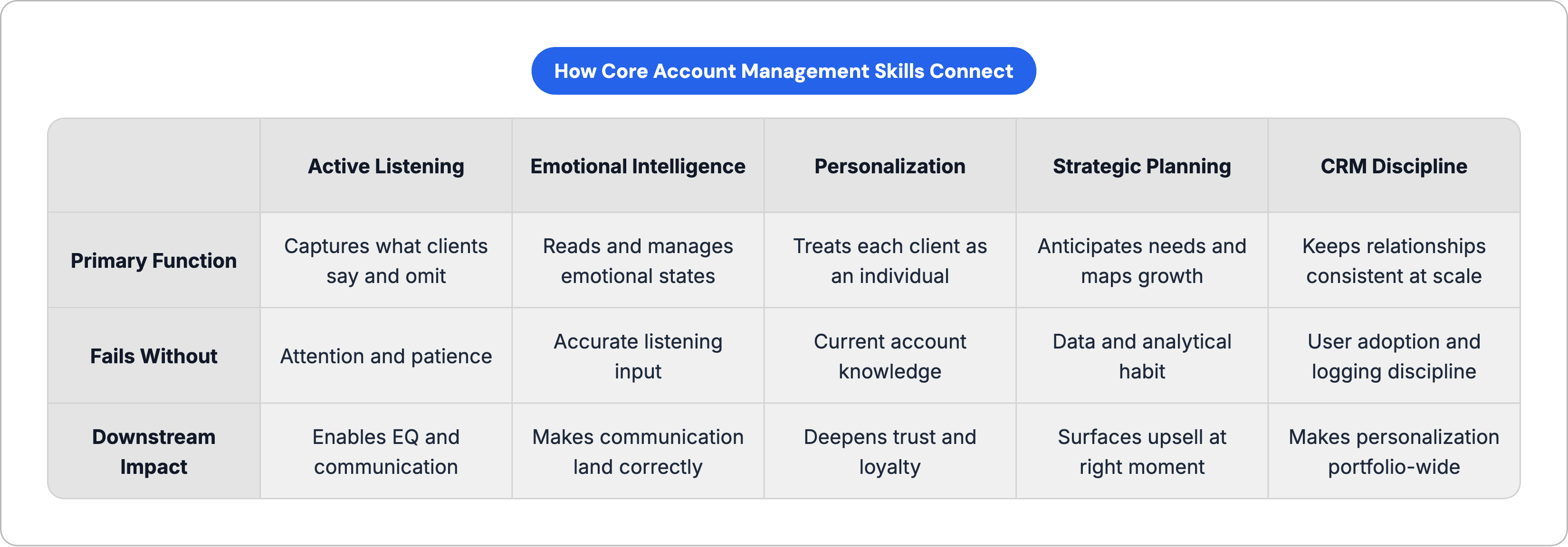
None of these work as standalone modules. Active listening feeds emotional intelligence directly, since you can't respond to a client's emotional state if you didn't hear it accurately in the first place. EQ then feeds communication, since managing your own reaction in a tense moment is what makes your next sentence land as reassuring instead of defensive.
Personalization only works if strategic planning is happening underneath it. Treating a client like an individual requires an actual maintained model of who they are, not a vague impression from six months back. CRM discipline keeps all of it consistent across an entire portfolio instead of limited to whichever accounts happen to be top of mind this week. Upselling sits downstream of everything else; it's what a well-run relationship eventually earns, not a skill you deploy to start one.
If you're auditing your own practice, look for the one skill quietly constraining the rest. A gap in listening makes emotional intelligence impossible to act on, no matter how self-aware you are, and a gap in CRM discipline makes personalization collapse the moment your portfolio grows past what you can hold in your head. Figure out which foundational skill is missing before investing in more advanced techniques.